Showing posts with label bus. Show all posts

Wednesday, July 22, 2020

Revisions to Metro's NextGen Bus Plan

Here is the good news.  After community outreach, Metro has made some revisions to its NextGen Bus Plan, and Line 218 has been saved, albeit in truncated form between Ventura Blvd. and Santa Monica Blvd.  Personally, I'd extend it from the Orange Line to Wilshire Blvd. (Purple Line), but I am grateful to see it survive it at all.


To review, the NextGen Bus Plan essentially takes the Rapid and Limited bus lines and combines them with their respective Local bus lines to create a more frequent overall service.  This approach has worked in improving ridership in other regions.  Here are the lines most relevant to West Hollywood:

Rapid 704 and Local 4 are combined into new frequent Line 4


Limited 302 and Locals 2 and 200 are combined to form frequent Line 2.


Rapid 705 is combined with Local 105 into new frequent Line 105.


Limited 312 is combined with Local 212 to create new frequent Line 212.


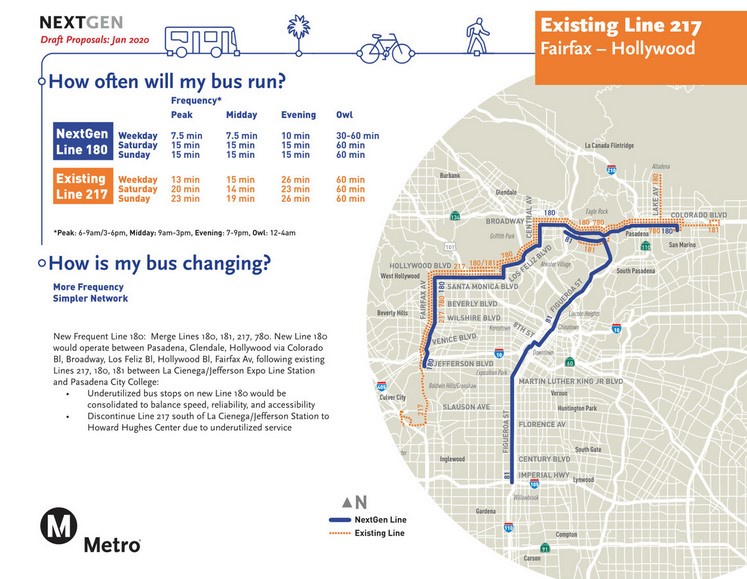
The change I find most fascinating is the merging of Rapid 780 with Locals 217, 180, and 181 into one new powerhouse frequent Line 180.


"In my opinion, this new frequent Line 180 is really going to need bus lanes on Hollywood Blvd. between La Brea and Vermont to work operationally."  Hollywood Blvd. is being considered for a makeover anyway, so now is the time.  So many bus lines start and finish on Hollywood, coming and going from all directions, that bus lanes on it make practical sense to me.

Here is one for my friends in Malibu.  Line 534 turns into Line 134 and has more frequent service.


I look forward to seeing the NextGen Bus Plan put into operation so that we can enjoy a more frequent service.  I've shown the major plans affecting West Hollywood, but you can see all of the NextGen Plan Updates by clicking here.

Monday, January 13, 2020

How Metro's Proposed Frequent Bus "NextGen Transit First Service Plan" Could Affect West Hollywood

Metro is undergoing a redesign of its bus network called the NextGen Bus Study.  After a series of community meetings, a draft frequency-enhanced "Transit First Service Plan" has been released.


The basic strategy as I understand it is to fold all but three rapid lines into corresponding local service, but increase the stop spacing on these new combined lines to create a core network where "83% of Metro's riders" will be walking distance from a bus that has 5, 7, or 10 minute frequency all day.  This sort of transformation to bus service has proven successful in other regions.


There are tradeoffs to any overhaul of course.  Metro is trading losing speed on individual rapid trips for the gain of frequency of service on many lines.  However, when one includes the time spent waiting for a bus as part of overall travel time, this may be a trade off that balances out for many people.  Check out all of the proposed changes by clicking here.


Here is how West Hollywood is likely to affected by the bus service changes according to the draft:

Santa Monica Blvd:  The Rapid 704 would fold into the a more frequent Local 4, with unproductive stops removed.  (Note: this may end West Hollywood's one-seat ride to Union Station.)

Sunset Blvd:  The Limited 302 would fold into the Local 2, with unproductive stops removed.  At Alvarado, the 2 would run north-south.  (Note: this would create a one-seat ride between UCLA and USC.)

Fairfax Avenue:  The Rapid 780 would be combined with the Local 180 and Local 217, for one new 180 line that runs from Pasadena City College to Hollywood Blvd., and then down Fairfax to the La Cienega "E (Expo) Line" Station.

La Cienega Blvd:   The Rapid 705 would fold into the Local 105, with unproductive stops removed.

San Vicente:  Line 30 would no longer run up San Vicente to West Hollywood, but Line 14 would.

La Brea:  The Limited 312 would be folded into the Local 212, with unproductive stops removed.

Crescent Heights:  Once proposed change I do not agree with is the elimination of Line 218 which currently runs over-the-hill between Laurel Canyon & Ventura Blvd. and Cedar Sinai Hospital via Laurel Canyon, Crescent Heights, Fairfax, and 3rd Street.  Elimination of this service would require new time consuming forced transfers for current Line 218 passengers on both sides of the mountain.  I suggest that Metro try redesigning the service first.  One proposal would cut out the 3rd Street portion, but extend the line north to the Orange Line, and run Line 218 between the Laurel Canyon Orange Line Station and The Grove, and see if feeding to/from the Orange Line improves overall performance.  Another possibility would be to extend the 230 south over the hill to Santa Monica Blvd.  I hope Metro considers these alternatives before scrapping a valuable, direct over-the-hill service entirely.


One thing that will be needed to make this bus network overhaul work:  BUS LANES!  Southern California needs a comprehensive network of color-painted and enforced bus lanes to compliment our (thankfully) growing and expanding Metrorail and Metrolink networks.

There are another series of upcoming community workshops on this frequent "NextGen Transit First Service Plan" all over the County over the next several weeks, including one in West Hollywood, on Wednesday, February 12, 2020, 4 – 7 PM, at Plummer Park, 7377 Santa Monica Blvd., West Hollywood, CA 90046 (Accessible via Metro Lines 4/704; and Weho Cityline).

Click here to find an upcoming community workshop near you.  You may send in your comments and suggestions about this plan to Metro at nextgen@metro.net. 


Thursday, July 25, 2019

What is Metro's NextGen Bus Study's Regional Service Concept

Metro has set out to design a new bus network that is more relevant, reflective of, and attractive to the residents of LA County, which it has branded as the NextGen Bus Study. This type of overhaul and updating of the bus system happens about every few decades. It's important to keep the bus network relevant and upgraded to represent current demand and travel patters.  Hopefully this will help with increasing Metro bus ridership as a similar redesign recently helped ridership in Austin, Texas.

Metro has completed Phase 1, its "Research and Analysis" phase.  Based on the data collected and a vast amount of outreach, Phase 2 is now presentation of Metro's "Regional Service Concept".  Phase 3, after the approval of the "Regional Service Concept", will be development of the "NextGen Service Plan", expected in early 2020. Phase 4 will be "Implementation" of the plan once approved.

So what is this Regional Service Concept that Metro is proposing to base design of its new service plan?

According to Metro, "Together with your comments, the Regional Service Concept is guiding the NextGen bus service planners as they examine every Metro bus line and bus stop to determine the best system redesign possible."  This phase will defines the goals and objectives of the new bus network, and will include measurements of for success of the new network, route and network design concepts based on public input and data analysis, a framework for balancing the inevitable tradeoffs that this new plan will require, and, of course, Metro’s Equity Platform considerations.

In 2018, the Board adopted Metro Vision 2028 as the agency’s strategic plan. Metro sees the NextGen Bus Study as addressing one of the plan's top goals: "Provide high quality mobility options that enable people to spend less time traveling."

The Concept lists three key factors to developing the new transit network:
  1.  Transit Propensity - Identity the areas where the propensity to use transit is the greatest, by examining the market segments of transit customers (transit reliant riders, commuters, and discretionary riders) and the intensity of demand by population and place (prospective ridership generators);
  2.  Existing Service Performance -  identify and optimize the most productive segments of the existing bus network which matches current transit demand (what's already working well);
  3.  Service Environment - Removing land use barriers to successful service, and implementing transit supportive infrastructure (such as transit-only lanes).
In particular, check out "Attachment E" (pages 151-157) of the Concept for signs of what bus lines Metro scores as performing well in the current network, and what lines it scores as underperforming.

I expect people will be very interested about any proposed changes to their current transit lines, for many people their transit access and reliability can determine their mobility, their economic prosperity, and social/cultural opportunity.

It will be months before we see the new proposed NextGen Service Plan.  While we are waiting, check out the NextGen Bus Study Data Center where Metro has granted access to an amazing ocean of transit data analysis, more than enough to keep any transit fan occupied until the NextGen Service Plan comes out by early 2020.

For a Ridership Data Tool that "allows you to explore monthly ridership stats, line level trends, and historical information for every line in Metro's system," please click here.

For a Trip Density Per Census Tract Map that displays volumes of daily trip origins per census tract, including both transit trips (recorded by TAP data) and overall trips (car, transit, etc.), please click here and zoom in/out.

For a Corridor Segment Performance Map that "displays which segments have the most ridership and are the most productive," please click here and zoom in/out.

For a Frequency Map that "displays how often buses are arriving at stops for segments of each route, with the red lines showing they most frequent segments," please click here and zoom in/out.

For a Trip Length Distribution Map that "displays how far riders typically travel along the corridor based on their starting point, with darker red dots indicating longer trip lengths," please click here and zoom in/out to click on a starting point to display the average length.

For an Origin-Destination Patterns Sliding Map that "displays the pattern of where current transit riders are starting and ending their trips," please click here and zoom in/out and slide back and forth to compare origins versus destinations.

For a Seated Capacity Map that "displays how full, on average, the buses are on segments of each route. The darker the color represents segments of a route where buses are fuller". please click here and zoom in/out..

For a Stop Level Ridership Map that "displays the level of activity at each of Metro’s bus stops, with the red dots representing high activity, with detailed information on the number of boardings, on and off, by simply clicking each dot/stop," please click here and zoom/in out.

For a Transit Propensity Map that "shows you the areas where the propensity to use transit is the greatest," please click here and add the layers of demand data you want while zooming in/out.

Phew!  That is a lot of data.  I cannot wait to see the new proposed service plan.

Wednesday, July 24, 2019

Please Give Us Shade... (No, Really.)

Last night I was waiting for a bus at Wilshire Blvd. and 26th Street at a major bus stop that serves local and rapid buses, and here is what I saw:


Notice something interesting?  Here is another view.


People are not sitting in the hot sun in the pretty, artistic seating.  They are standing in the shadows of poles and trees.  This is how too many people wait for the bus in Southern California.  If you are a big and tall guy like me, the pole may not be big enough.


My question is. why isn't there a bus shelter?  Why isn't there shade?  It makes for a very uncomfortable wait.  When it rains, and we know from this year that it actually does rain in Southern California, we basically get wet.

Here is an example of a London bus shelter design  I love -- that has shade, seating, a map, a digital screen, and is ADA compliant -- that I would like to see all through Southern California.


Isn't this pretty?  Why don't we have adequate bus shelters throughout much of Southern California?   Don't blame Metro for this.  The quality (or lack thereof) of bus shelters and bus stops is largely the responsibility of  the cities in which they are located.

Also, are bus stops designed based on how aesthetically pleasing they look or for the benefit of the transit user?  Ideally both, but functionality is essential.

By pointing out this stop, I am not ragging on the transit-supportive city of Santa Monica here, or its terrific Big Blue Bus system.  This one stop is just an indicator of a county-wide deficiency.  I should also add that my city of West Hollywood is currently upgrading its bus stops and shelters, which is terrific.  But, if you don't have adequate bus stop shade where you live, work, and play, then go to your city's Transportation Commission meeting, or even its City Council meeting, and insist on quality bus shelters that offer real shade from the sun and rain during public comment. 

As I stated in my last blog, there are two basic views of public transit and its components that I run across:

(A)  "Public transit is method of moving masses of people of all classes and demographics conveniently from place to place, increasing mobility, cultural opportunity, and economic prosperity, while helping the environment and quality of life for all by providing an reliable alternative for people who would otherwise exacerbate traffic problems by driving more cars on our already clogged roads."

(B)  "Public transit is a form of "transportation welfare" meant to provide a subsistence level of mobility to poor people who would, of course, get their own automobile as soon as they have the means and opportunity."

Too many people think of transit in Southern California solely as (B) and therefore don't see the problem here.  If you only think of transit as just transportation welfare for poor people who would rather be driving a car, then you probably don't care about investing in or improving the system, or the experience of the transit rider. 

Having lived in New York, and other Metropolitan cities, I envision transit as (A), and that is why I seek to improve it for everyone in the Southern California region, because I see everyone as a potential user.  I absolutely reject the limited, outdated idea that "this is Southern California and we have a car culture, so mass transit will never work here."  Millions of people already use the system we have and voters passed Measures R (2008) and M (2016) to improve and expand our system.

One person has told me dismissively, "if we build transit shelters, the homeless will simply camp out in them".  Not if we adequately address the issue of homelessness, which is a whole other blog topic.  I also reject the idea that the severe issue of homelessness in Southern California should limit or be dumped on our transit system and its components.  Let's solve BOTH issues.

I don't write this blog post to complain.  I truly believe in mass transit as a public good, and a public good right here in Southern California.  If there is an amazing bus shelter in London, we here deserve no less.  If there is any amazing transit feature (signage, maps, technology) in any other city around the world, Los Angeles County deserves it too.  This a world class metropolitan capital of culture and commerce and we should have a transit system that is top of the line, and in the front of innovation -- not as an afterthought because, of course, we'd all rather be driving an automobile.  Let's have a world class transit system for everyone worthy of a City and County of Angels.

In order to have the robust, user-friendly rail and bus transit system we all want, please give sunny (and sometimes rainy) Southern California adequate shade at all its transit stops.

-----

Edited to Add:  Please read this excellent Places Journal essay on "Shade", which explains who in Southern California gets shade (and who doesn't) and why.  Please click here to read.

Tuesday, August 14, 2012

Can we get higher capacity buses on the Orange Line?

As those of you who have read this blog know, I believe the Orange Line should have been built as and should be upgraded now as a light-rail line.

In the meantime, every time I ride the bus line everyone is stuffed like sardines into regular articulated buses.  Why not have tri-articulated buses as they have for other BRT systems in the world?

Here are two examples of what these type of buses look like.


Metro, can we purchase some of these so we can breathe again?


Thursday, June 7, 2012

Metro Service Adjustments Coming on June 17th

Here are the bus changes affecting the West Hollywood / Hollywood / Beverly Hills area beginning Sunday, June 17th:

-----

Metro Line 30 
West Hollywood-Pico/Rimpau-Downtown LA-Indiana Station via San Vicente, Pico Bl & East 1st St

New route extension to West Hollywood. Select trips operate on San Vicente Bl between Pico/Rimpau Transit Center and West Hollywood. Service east of Downtown LA will serve 1st St in both directions. All trips will operate through the Pico/Rimpau Transit Center.

-----

Metro Line 330
West Hollywood-Pico/Rimpau-Downtown LA-Little Tokyo Station via San Vicente & Pico Bl

New peak hour limited stop service replaces Line 730. This new service makes all stops on Broadway in Downtown LA with new stops at Pico/Arlington and Pico/Crenshaw. Select trips operate on San Vicente Bl between Pico/Rimpau Transit Center and West Hollywood.

-----

Metro Line 217 
Hollywood/Vine Station-Fairfax -Culver City Transit Center via Hollywood Bl, Fairfax Av & La Cienega Bl

All trips extended to the Metro Expo Line La Cienega/Jefferson Station and select trips extended further south along route of former Line 439 to provide new all weekday service to Culver City Transit Center.

-----

Metro Line 220 
Beverly Center-Culver City via Robertson Bl

Route modified to serve Metro Expo Line Culver City Station.

-----

Metro Line 305
Westwood-Leimert Park-South LA-Willowbrook

Route discontinued. Service on San Vicente Bl has been replaced with Lines 30 and 330.

-----

Metro Line 439
Downtown LA-Culver City Transit Center via I-10 Fwy

Line discontinued. See Line 217 description for replacement service.

-----

Metro Line 534
Malibu Express-Washington/Fairfax Transit Hub via Pacific Coast Hwy

All trips exit/enter I-10 Freeway from Robertson Bl to serve the Metro Expo Line Culver City Station at Venice/Robertson for an improved connection to Downtown LA. Service continues to Washington/Fairfax Transit Hub.

-----

Metro Line 550
Exposition Park-Artesia Transit Center -San Pedro via Harbor Transitway

Route modification terminates all weekday rush hour trips at USC/Expo Park. Non-rush hour and all weekend trips will terminate at Artesia Transit Center. Service to West Hollywood has been replaced with Lines 30 and 330.

-----

Metro Line 705
West Hollywood-Vernon via La Cienega Bl & Vernon Av

New stop added at Metro Expo Line La Cienega/Jefferson Station.

-----

Metro Line 730
Downtown LA-Pico/Rimpau via Pico Bl

Service replaced by Line 330.

-----

Metro Line 761
Pacoima-Westwood via Van Nuys Bl & Sepulveda Bl

New stop added at Van Nuys and Plummer.

------

Many of the bus service changes have to do with the opening of the first-half of the Expo Line between downtown Los Angeles and Culver City, and the subsequent need to optimize services accordingly.

For a complete list of all of Metro's coming service changes, check Metro's website or it's blog The Source.

Tuesday, May 1, 2012

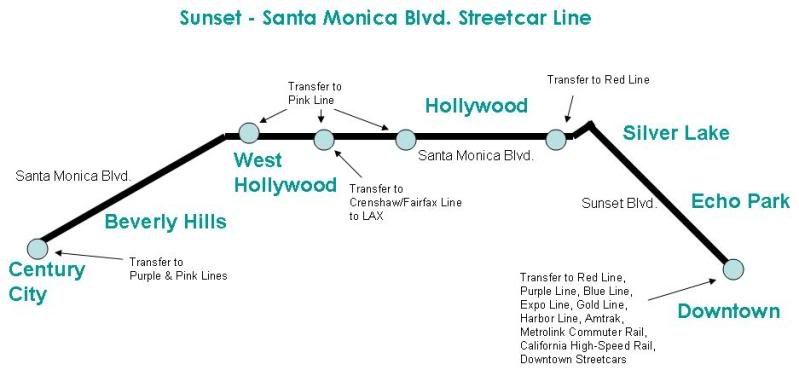
Calling for a transit-only lane on Santa Monica Blvd. - Sunset Blvd. between Santa Monica and Union Station

I consider myself the biggest cheerleader of bringing Metrorail to the West Hollywood environs.  And with luck, the northern extension of the Crenshaw/LAX light-rail line will be routed to Hollywood via West Hollywood and its neighboring areas.

However, we shouldn't forget surface transit.  Even with Metrorail, major corridors throughout Southern California are also going to need transit-only lanes allowing for speedy service for buses and modern streetcar trams to connect people to the "first/last mile" of the their journey.  We will need a full network of transit-only lanes all over the county (in addition to bicycle lanes).

Here's a sample pic of what this might look like.


As part of this, in addition to the Purple Line expansion as part of the Westside Subway Extension, there is currently a project to bring bus rapid transit to Wilshire Blvd.

I will be the first to stand up and call for a Santa Monica Blvd. transit-only lane between the ocean and Sunset Junction, further heading downtown to Union Station.

As a transit-only lane, it could potentially run modern streetcars quickly and efficiently.  Just imagine...


Now my willingness to take lanes away from cars to allow for more mobility for transit and bicycles may doom any chances I might ever have to get elected to political office in Southern California or it may not.  (No, I am not a candidate for anything.)  But the golden era of cheap gasoline and the single-occupancy automobile in southern California is LONG behind us.  Even if we "drill, baby, drill", $2/gallon gasoline is gone forever.  It's a global market and China and India are not going to stay in the third world so that we can drive our SUVs cheaply across the streets of  Los Angeles.  Therefore, we need to consider practical ways to expand mass transit mobility affordably like any other world class metropolitan region.

So let's bring a transit-only lane to Santa Monica Blvd. while we continue to advocate for Metrorail.


A Los Angeles eye view of Toronto Transit

Recently I had the privilege of being in Toronto, Ontario, Canada.    Toronto is an amazing city with great people, great food, and a great transit system.  In fact, like Los Angeles, Toronto's is in the process of a huge expansion of its mass transit system -- truly a world class city unfolding.

Though attending a business conference, I had a little free time and I used it to sample Toronto's transit system and to see how Toronto's current system could inspire user-friendly changes to our own expanding system.

I took pictures.  (My apologies for any blurry pics, I make NO claims on being a good photographer.)


Here is a subway entrance and something you rarely see in Los Angeles -- an actual transit shelter for streetcars and buses.


This streetcar and bus stop has a shelter with a CURRENT systemwide map on it.  Why can't we have transit stops with covered shelters and/or current transit system maps posted on them to make it easy and convenient on riders.

Here was my day pass in Toronto.  It works like a scratch lotto ticket.

Here is a daily free newspaper "Metro" that people pick up to read in transit stations.  There was also a Metro free daily that I read on the London "tube" when I lived there.

Here is a fully underground grocery store.  Makes for very convenient shopping on the way home.

Never underestimate the value of CURRENT system maps as well as station area maps to help riders.

This subway car has a sign that points to which side of the subway car will have the doors open.

Here is an electronic map in the subway car that points out where you are in the system and what the next stop is -- very convenient!

Notice the television screen in the subway with accurate up-to-date information

Another tubular type of platform -- very London-esqe.

And because there are people who use paper day passes even with turnstiles, there will need to be human monitors at subway entrances to allow those people through.  (Note to Metro that is considering locking subway entrances -- you will still need to have human monitors at the stations for regional paper pass holders like me.)

Nice how subway entrances are located within office complexes.  When the Century City station on the Purple Line is built as well as a future 5th/Flower subway station infilled on the Regional Connector, think of the possibilities.

Whoops.  This subway station had multiple entrances only this one did not have a human monitor.   Those entrances need to be labeled.

Note this nice weather protected entrance to the subway station.  It gives you a chance to open your umbrella before going outside or closing it before you head down the escalator.

One of the things I miss the most from New York and London subway systems are the buskers.  Why not have quality musicians playing in the system for tips?

Look that something you hardly ever see anymore -- pay phones, plus a lotto stand in the subway.

Look, a convenience store within the subway station -- for buying a newspaper or picking up breath mints prior to that important business meeting.

Here is the inside of a spacious subway car.  The Red/Purple Line cars in Los Angeles are poorly designed  The middle seats should be back-to-back to give a more open feeling.

Look at the clear bag trash receptacles that include recycling and a machine to get your transfer (which Metro doesn't do anymore.)

The downtown subway stations connect to full service malls underneath office buildings.


Here is a subway entrance with two service windows and several turnstiles.


Here are the Toronto equivalent of Zipcars.

What?  You thought gasoline was $1.30 a gallon in Canada?  Nope.  That's per liter.  The "drill, baby, drill" fools think that we can drill our way back to $2 a gallon gasoline.  It is a global oil market and China and India are not going to stay in the third world so that suburban/exurban residents can drive gas guzzling SUVs in America cheaply.

Here is a Toronto streetcar that comfortable rides in traffic at grade.  (Think of how much quicker they would be if these were transit only lanes.)  Modern streetcars are coming to Los Angeles in just a few years.  Woo hoo!

Personally, I think the overhead wires and tracks of the streetcars aren't blight.  They are part of the ambiance of the city.

As part of its transit system, Toronto allows you to rent a bicycle.  All part of the convenience of a transit friendly city.

The one thing I didn't have time to do is ride the ferry to the Toronto City Airport.  Toronto is planning rail links to Pearson International Airport.

Metro can adopt some of these amenities.  Your local city or neighborhood council can adopt some of the others.  Public-Private Partnerships are possible.

Now, sometimes as I discuss the growing transit network in Los Angeles I will hear someone say, "but what about my automobile?  I love my car and don't want to to give it up."  To which I say, "Uh, no one is asking you to.  Keep your car.  There are millions of others who want to have an alternative."  And Toronto, like New York and London and Tokyo and other cities with world class transit systems, there are also millions of automobiles as well.

So here's to Toronto.  I look forward to witnessing the unfolding expansion of transit both there and back here in Southern California.