Showing posts with label Red Line. Show all posts

Wednesday, April 11, 2012

What will eventually be the northern extension of the Crenshaw/LAX Line to Hollywood?

On the new Expo light-rail line there is a stop at Crenshaw & Expo, which will eventually be a transfer to the proposed Crenshaw/LAX light-rail line.  Most transit advocates in Southern California see the natural northern terminal of the Crenshaw/LAX Line not at the Expo Line where the first operating segment will end, but past Wilshire Blvd. and the Purple Line to the Hollywood/Highland Red Line station.

When Metro finally studies this transit corridor they will have to consider the needs of all the stakeholders in the area.

There will be those people who primarily care about getting the quickest and most direct route between Crenshaw/Expo and the Hollywood/Highland station and they will want La Brea as the alignment obviously.

Then there will be people who live, work, play and want to travel to/from high ridership destinations in between these two points, especially West Hollywood and surrounding destinations, who were disappointed in not being part of the Westside subway extension and whom voted most heavily in favor of Measure R, and their primary concern will be accessing Metrorail at all.

Metro will need to balance the cost of building a longer alignment to provide access to more stakeholders with the desire of those who primarily want speed through this area to create an alignment that serve the most people with the maximum ridership. ALL of the potential alignments through this area would still be quicker than riding a bus through traffic.

Here are the most likely potential alignments of the northern extension of the Crenshaw/LAX line as shown in this Metro study map:


Here are my guesses of the most probable potential stops with their accompanying ridership destinations, along with the length of these potential alignments connecting Crenshaw/LAX at the Expo Line station with Hollywood/Highland:

All of these four alignments would have stations at
- Crenshaw and Expo (transfer to Expo Line)
- Crenshaw and Adams
- San Vicente and Pico/Venice

Here is where they differ on the route to the Hollywood / Highland Red Line station

---------------

SAN VICENTE / LA BREA ALIGNMENT (4.2 miles total)

- Wilshire/LaBrea (needs to junction with LaBrea/Wilshire Purple Line station)
- Beverly/LaBrea
- SantaMonica/LaBrea 
- Hollywood/Highland

(This route misses nearly all of the high-ridership generators in this area, and would be sort of like running the Blue Line up Alameda instead of the heart of downtown to Union Station.  You'd get there the quickest, but miss where the riders are actually going in between.)

-------------

SAN VICENTE / FAIRFAX / SUNSET ALIGNMENT (6.0 miles total)

- Wilshire/Fairfax (LACMA/Museum Row - needs to junction with Fairfax/Wilshire Purple Line station
- Beverly/Fairfax (Grove/Farmer's Market/CBS)
- Santa Monica Blvd/Fairfax (West Hollywood east)
- Sunset/Gardner (Sunset Strip access)
- Hollywood/Highland

(As this was the original northern alignment of the Red Line before the NIMBYs thwarted the Purple Line extension through Hancock Park back in the 80's, there would be sweet justice of a Fairfax alignment eventually being built.)

-------------

SAN VICENTE / LA CIENEGA / SUNSET ALIGNMENT (around 7 miles total)

- Wilshire/SanVicente (transfer junction with LaCienega/Wilshire Purple Line station)
- Beverly/LaCienega (Beverly Center / Cedar Sinai)
- SantaMonica/LaCienega (heart of West Hollywood)
- Sunset/Fairfax (Sunset Strip access)
- Hollywood/Highland

-------------

SAN VICENTE/SANTA MONICA BLVD. ALIGNMENT (7.3 miles total)

- Wilshire/SanVicente (transfer junction with LaCienega/Wilshire Purple Line station)
- SanVicente/Beverly (Beverly Center / Cedar Sinai)
- SantaMonica/SanVicente (heart of West Hollywood)
- Santa Monica/Fairfax (West Hollywood east)
- Santa Monica/LaBrea
- Hollywood/Highland

(This alignment has the advantage of the portion north of Wilshire as already having been studied by Metro as part of the Westside subway extension.)

--------------

Why not have two or three separate Metro rail lines some people might ask?  Why not have one line traveling only on LaBrea for speed between Hollywood and LAX and another separate line entirely that integrates West Hollywood and environs for access into the Metrorail system.  Why not indeed?  

Well, to be frank, two or more lines won't happen because of MONEY -- because nearly all of this light-rail line will have be constructed underground.   (Look at the current difficulty in getting the Wilshire Blvd. subway extension and the Regional Connector projects funded and built.) 

If we are lucky and the pieces somehow come together, we will get to have one light-rail subway funded and constructed through this mid-city, mid-west side area.  ONE.  And it is going to need to serve all the stakeholders, or as many stakeholders as possible, in this area, not just those transit riders traveling between Hollywood and the airport quickly, but also those who live, work and play in points between such as the Grove, Beverly Center, Cedar Sinai, West Hollywood, the Sunset Strip, and their environs.

Not just because it is geographically in the middle between the other alignments and in the middle with the lengths of these alignment, I think Metro may end up deciding that Fairfax is the best compromise alignment between ridership destinations and speed through the area, but we will see.  Everyone will have their vocal opinion I am sure.  Hopefully, either the SanVicente/SantaMonica alignment or the SanVicente/Fairfax alignment will be built in our lifetimes.

Tuesday, October 13, 2009

Everybody Ride the Sunset Streetcar


You may not be aware that streetcars will be returning to downtown Los Angeles in a soon as five years, but they are.


From the Los Angeles Streetcar website:

"Streetcars are designed to be a constant fixture of urban transportation options for residents, employees, and visitors; they are very different from the Metro rail transportation and subway system that Los Angelinos are used to. A streetcar, unlike light rail, travels in the flow of traffic on rails that are embedded in the road. Automobile drivers traveling in the same lane as the streetcar rarely notice that they are driving on top of rails. Although traveling at speeds similar to those of a bus, streetcars are the preferred downtown circulators due to the comforts offered by fixed-rails during their short trips. Because the streetcar runs on a fixed route, riders can be assured that the route will never change, and appropriate technology, kiosks, architecture, and guideways can be integrated into the urban environment to provide route guidance."

If you have been to San Francisco, you have probably seen the old streetcars from around the world carrying passengers between the Castro, downtown and Fisherman's Wharf. What we will likely see here are the newer modern streetcars like those seen in Portland and Seattle.


Some of you are saying, "Don't we have buses already that go to these places"? Well, true. However, there are "choice" riders who won't use a bumpy uncomfortable bus, but do like more the comfortable ride that streetcars bring. Streetcars also have been shown to attract development and revitalize neighborhoods.

From the Los Angeles Streetcar website:


"Buses are excellent local and regional public transportation options, but they will do little to spur redevelopment and economic investment in Downtown LA. This is due to the inherent flexibility of bus service, as routes change regularly to accommodate varying needs; in addition, buses contribute to nerve-racking pedestrian experiences due to heavy street-level emissions and noise pollution that discourses active use of sidewalks. Streetcars do the exact opposite. They provide developers and business owners certainty that the routes will not change, and are considered preferable to buses by residents, visitors, and employees as they offer more amenities, highly reliable routes and timetables, and enhanced urban experiences. Buses and streetcars do, however, work together to connect access points within regional transportation networks. For example, sidewalks can be designed to specifically accommodate both vehicle configurations; in return, a transit stop effectively doubles its value within a regional transportation network."
The planned downtown alignment runs down Broadway.


This led me thinking about other parts of the area that might benefit from Streetcar service, especially areas that desire rail service, but are unlikely to see heavy or light rail in the next few decades, but for whom streetcar service could be up and running in the next few years.

Ventura Blvd. between Universal City and Warner Center came to mind. Also, I imagined connecting Venice Beach and Santa Monica north/south to the Expo Line and Purple Line. I am sure you have your own ideas.

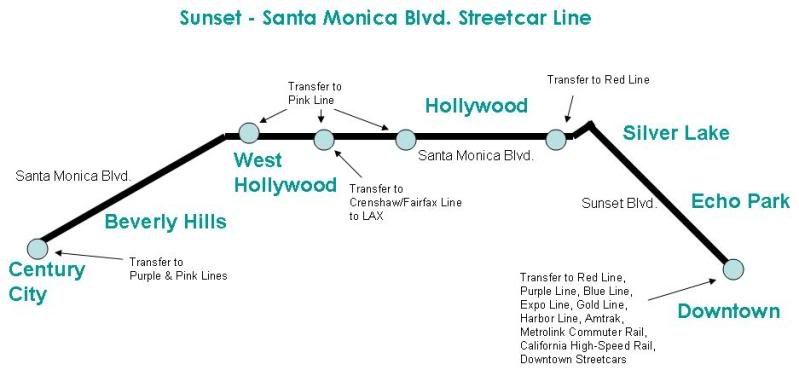
However, what I'd really like to propose for your thoughts today is a Streetcar connecting downtown and Hollywood via Sunset Blvd., through Echo Park and Silver Lake. The first leg could connect downtown and the Red Line. Extensions could go further along Sunset Blvd. to the Sunset Strip and along Santa Monica Blvd. to Century City via the unused right-of-way in Beverly Hills. 


There would actually be two streetcar lines using the same tracks on the West and East end, but running on different streets in the middle.

Both Lines would run from Union Station to Sunset Junction.

Line 1 would run on Santa Monica Blvd. between Sunset Junction and San Vicente.

Line 2 would run on Sunset Blvd. from Sunset Junction to the Strip and then south on San Vicente to Santa Monica Blvd.

Both Lines would be reunite at San Vicente & Santa Monica Blvd. and then head to Century City via the unused right-of-way in Beverly Hills.

The tourists will love it, of course. More importantly, regular commuters will use it.

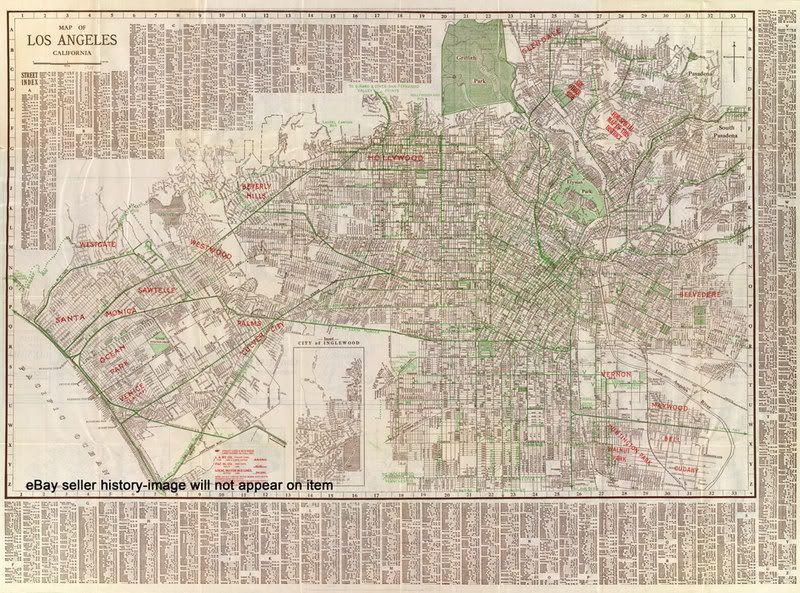
When someone says, "this town was built for cars", show them this map below and remind them that it was RAIL that built up Los Angeles and California. Just look at what we lost fifty years ago. If we had not tragically dismantled the streetcar system, but improved it over the last several decades, we'd have an amazing system already in place now. (Please click on image below to see whole map. You may want to keep kleenex nearby for weeping purposes.)


However, we move forward and the upcoming return of streetcars to Los Angeles is something to celebrate along with the expansion to Metro Rail that Measure R funds will bring. All hail as we leave the car-only transportation culture behind. Los Angeles is transforming into the world class metropolitan city is deserves to be.