Tuesday, August 17, 2010

The Other Side of the President's Visit to Los Angeles - The Forgotten and Marginalized Transit Rider

Last night it took me two and one-half hours to get from Pico/Roxbury to West Hollywood by bus. You see, the President was in town at a million dollar fundraiser.


http://www.latimes.com/news/nationworld/nation/la-na-obama-la-20100817,0,485361,print.story


While the President was raising money from the rich and powerful, thousands of commuters were faced with no way to get home.


"What a spectacular evening," Obama said. "Let's just hang out."


Yeah. Great. I was “hanging out” at bus stops with nowhere to go. There was no northbound traffic on La Cienega and Fairfax. Buses on Pico were at a standstill. I had to take a crawling bus on Pico to WESTERN, then north on Western to Santa Monica Blvd. Whoops! The buses were not running east on Santa Monica Blvd. past Western either. So I had to catch another bus north on Western to catch a bus on Sunset Blvd., which thankfully was still running.


At each bus stop I waited at there were crowds of people not having any idea the President was in town, let alone how they were to get home.


According to the Los Angeles Times, the Los Angeles Police Department said that the Secret Service had not shared street-closure information with the department. The Secret Service also didn't tell Metro. So in other words, there was no ability to plan for this nightmare and no warning people would have that there would be disruptions to their lives. What about the people that had to get home to their kids?


Now contrast this with the wealthy and powerful at the fundraiser who no doubt had the best in valet parking. Congratulating themselves at their concern for the plight of the hardworking American people, they were no doubt perfectly attended to while the working poor were invisible, irrelevant and inconvenienced.


Isn’t this just a living metaphor for America today? In the greatest recession since the great depression the wealthy and powerful got the attention and priority and congratulations while the working and middle classes were left to fend for themselves with no resources. And the President and local political leadership were, of course, at a FUNDRAISER.


So who is to blame for this?


Didn’t it occur to anyone on the President’s staff that the bad feeling and anger that this commuting nightmare would cause might outweigh all the benefit of “hanging out” at this fundraiser?


Didn’t it occur to the city/county leadership and to Metro to announce the following: “The President is in town during rush hour for a fundraiser, and the Secret Service won’t tell us the routing, so you may not be able to get home that evening.”


Now I lived in Manhattan for several years and when the President came to town there were underground alternatives to getting around while the surface streets were disrupted. My only hope is that the President and Congress approve Metro’s 30/10 Plan, which would pay for construction of the Purple Line extension in 10 years, and that money comes in from somewhere to pay for the Santa Monica Blvd. alignment and the extension of the proposed Crenshaw Line north to Hollywood and a Sepulveda line connecting the San Fernando Valley with the westside and LAX.


But that best case scenario is in the best case ten years from now. In the meantime, how we can ensure that this won’t happen again or that we will at least be informed that we won’t be able to get home the next time this or a future President has a mid-city rush hour fundraiser with the elites?


I have a feeling based on the bad PR coming from the traffic/transit nightmare that this fundraiser caused, that future Presidential fundraisers will be held in lest disruptive locations like someone's Malibu beach home.

Thursday, July 1, 2010

Venice Blvd. Streetcar Proposal

A friend of mine who sits on the Palms Neighborhood Council thinks it would be great having a streetcar connecting the LaCienega station on the coming light-rail Exposition Line to Venice Beach.

Extending that idea eastward to a northern extension of the Measure R approved Crenshaw Line, and imagining a future LRT on Sepulveda and Lincoln, it would look something like this:


When streetcars return to Los Angeles in a few years I am convinced that many areas that will never see heavy-rail subway or above-ground light-rail, will be interested in at-grade modern streetcars such as those currently running in Portland and Seattle.


Wednesday, June 30, 2010

What about upgrading the Orange Line to Light Rail?

Let me preface this blog post by stating I think bus service is wonderful, and I support a county-wide network of transit only lanes and busways.

However, I do not subscribe to the belief that a seat on the bus is as "good" as a seat on a train, nor do I agree with the choice of Metro to brand busways with official colors like the "Orange Line" and the "Silver Line".


The San Fernando Valley seems to be left out of mass transit planning in Southern California. Meanwhile the entire San Gabriel Valley political structure is united and is eagerly anticipating two or more Gold Line extensions eventually on the northern prong to Montclair and even Ontario Airport and on the southern prong to possibly Whittier and/or Duarte. The reason for this is obvious. With our oversized, too populous, too few legislative districts at the national, state, county and municipal level, many of the politicos who represent the southern San Fernando Valley also represent and have their power bases in the Westside. All of their attention is going toward extending the Purple Line to the Westside, which of course is the most needed and highest profile transit project in planning.


Just how did this former rail corridor end up as a busway anyway?


From Wikipedia:


The majority of the Orange Line is built on part of the former Southern Pacific Railroad Burbank Branch right-of-way. This had passenger service from 1904 to 1920, with stations at several locations including North Hollywood and Van Nuys. It had Pacific Electric Red Car service fromNorth Hollywood to Van Nuys again from 1938 to 1952.


The right of way was purchased by the Los Angeles County Transportation Commission (now Metropolitan Transportation Authority) in 1991 along with several other rail road right of ways across the Southland for future use in transportation projects.


The California Legislature passed a law in 1991 introduced by Alan Robbins which prohibited the use of the corridor for any form of rail transit other than a "deep bore subway located at least 25 feet below ground". Later Los Angeles County passed Proposition A in 1998, promoted by supervisor Zev Yaroslavsky, which prohibited Metro from using its county sales tax funding to build subways anywhere in the county.


With subway and light rail now off the table the only option left to develop the transit corridor was to build a busway.


The "Orange Line" busway is already at capacity and shows the limits of BRT. The San Fernando Valley deserves an east-west rail project that connects Warner Center with the Red Line (and could potentially be extended east through Burbank and Glendale to meet up with the Gold Line in Pasadena). Since the San Fernando Valley politicos are focused elsewhere, it is up to you and me to remind them that simply extending a busway north doesn't cut it. Perhaps some of you could lobby to get VICA (Valley Industry and Commerce Association) behind an east-west line and a north-south line for the San Fernando Valley. If the San Gabriel Valley is getting two light rail lines, the San Fernando Valley deserves no less.


In Measure R which was approved by voters in 2008, there is a project study for a north-south transit project connecting the Orange Line with Wilshire/Westwood through the Sepulveda Pass. If this were a rail project, many local transit advocates see it logically being extended south down to LAX and north up to Sylmar Metrolink. That would take care of a needed north-south rail line for the San Fernando Valley.


What about east-west rail travel? The most obvious solution is to upgrade the existing Orange Line to light rail.


I asked the incomparable Kymberleigh Richards (http://transit-insider.org), member of Metro's San Fernando Valley Governance Council, her thoughts on the issue and the possible challenges and here is what she had to say:


Here are the problems that would be faced:


1. You would need to retrofit the busway without seriously disrupting existing service, otherwise what's the point? You wouldn't want to inconvenience the existing passengers by forcing them to a slower alternative during construction. The most likely way to proceed would be to close one segment at a time, one lane at a time, then cut grooves into the pavement down to the roadbed and install the rails so that they were flush with the pavement (like a grade crossing, only along the entire alignment) then reopen the lane to bus traffic. Service would continue to run with only a minor delay by using the remaining open lane to run both directions, with flagmen. Grade crossings would require a bit more logistics, especially the major arterials like Van NuysBlvd.


2. You would have to use a low floor light rail vehicle in order to avoid having to retrofit the existing station platforms. This means the existing light rail cars would not be compatible with the Orange Line. So there would be a third fleet of LRVs at Metro; heavy rail subway (Red/Purple), high floor/high platform light rail (Blue/Green/Gold/Expo/Crenshaw) and low floor/low platform light rail (Orange). So forget any Orange Line extensions that would interline with something else.


3. Because of the constraints of construction, the technology will have to be something other than overhead catenary for power. Installing that would require full busway closure for longer periods of time, which puts us back to inconveniencing passengers during construction. Third rail power, like the Red/Purple Line, is also out of the question because of the open-air operation (you can't have passengers in danger of making contact with the electric source). A DMU, like the San Diego system, is going to be far too expensive for this and brings constraints of its own to the process. So either you need a protectedthird rail (very costly; they are experimenting with this in some of the Middle Eastern countries, where cost is no object) or a self-contained, rechargeable on-board power source. Perhaps some type of storage battery that could plug in at the layovers?


4. The street running segment between Canoga Station and Warner Center would have to be negotiated with traffic engineers at LADOT. I doubt they'd give up traffic lanes for the light rail, and I don't savor the idea of running light rail in mixed-flow traffic.


And of course, you'd have to do an entire new scoping/AA/EIR/EIS and figure out where the funding is coming from. Just that last part (the $$$) pretty much means all the Measure R projects would have to be underway and near completion before you could start programming funds for an Orange Line upgrade.


No one has ever done a busway-to-light rail conversion. We'd be breaking new ground, which is why there's no hard research available on the subject.


Hmm. Sounds problematic, doesn't it? However, why couldn't this be the first corridor to attempt a busway to light-rail conversion? I'm game.


In any event, the Robbins bill would have to be repealed for any light rail project, so start lobbying your state legislators if you want to see ANY rail service in this area, for a subway ain't coming to this corridor this century.


What about alternatives? Metrolink commuter rail is in the northern San Fernando Valley, but many people travelling to the San Fernando Valley are travelling to/from a destination on or near Ventura Blvd. in the southern part of the Valley.


1) San Fernando Valley transit advocates could lobby for a subway under Ventura Blvd. connecting Warner Center with the Universal City station. Yes, sounds great. Only there are easily 50 years of subway projects ahead in line, assuming those actually get full funding and constructed.


2) San Fernando Valley transit advocates could lobby for a transit-only lane on Ventura Blvd. that ran buses and modern streetcars. This would require taking away street parking on Ventura Blvd. and possibly losing a lane of traffic each way. I have no problem with this as I don't believe we can or should socially engineer our cities in favor of single-occupancy motorists anymore, but I suspect not a few single-occupancy motorists would object. However, a streetcar is much less expensive than a subway and could be up and running within a few years, while it will be decades before we would see a subway on Ventura Blvd. Here's a fun map I created for a Ventura Blvd. streetcar project to spur your imagination:


One challenge of doing some project on Ventura Blvd. means you need to find another way to connect Burbank and Glendale into Metrorail.

Your thoughts?

Thursday, June 24, 2010

One Seat Ride to the Beach or to LAX?


For Westside Subway Extension supporters, this is our dream:


I count myself as the BIGGEST support of a Santa Monica Blvd. subway project, colloquially nicknamed the "Pink Line".

However, only the first three minimum operating segments (extending the Purple Line west from Wilshire/Western to Wilshire/Fairfax, to Century City, to Westwood) of the Westside Subway Extension project are likely to go forward for Federal funding at this time, in no small part because of the money that was already thankfully approved by Measure R for that portion of this project and not the other portions, and because the cost-benefit ratio for the first three minimum operating segments meets current federal guidelines for matching funds.


Alternatives 4 and 5 have the West Hollywood subway spur included. (This chart is also not good news for the City of Santa Monica which wants the full extension of the Purple Line to the beach which is in Alternatives 3 and 5).

Therefore, because of the above chart, this is what will likely be constructed within 10 years if Mayor Villaraigosa's 30-year plan goes through.


Supporters of MOS-5, the segment of the Purple Line west of the V.A. grounds, have little choice but to pursue Federal funding later and keep lobbying for Metro to build the full extension to the beach.

Those of us who support MOS-4, the West Hollywood spur, have a couple of options, if Metro abandons us (even though West Hollywood voted 83% in favor of Measure R, more than any other city).

Option 1) Continue to lobby for the Purple Line spur between Beverly Hills and Hollywood along Santa Monica Blvd. seen above, understanding that we are not part of Measure R funding, and are unlikely to be constructed within the next several years if not a few decades.

Option 2) Lobby for the Santa Monica Blvd. alignment to become part of the northern extension of the Crenshaw Line, which Measure R will see constructed as light-rail between the Expo Line and LAX. The tradeoff would be a one-seat ride to/from LAX instead of a one-seat ride to/from the beach. While the northern extension of the Crenshaw Line to the Hollywood/Highland Red Line station is not funded by Measure R north of the Exposition Line transfer, and as this is a light-rail project rather than the heavy-rail subway extension of the Purple Line, and as it will not all be underground, and therefore likely to be less expensive, it may be more easily funded and built sooner.

Here's a map showing the Santa Monica Blvd. alignment as an alternative to link the Crenshaw Line at Expo/Crenshaw to the Hollywood/Highland station as light rail:


Here is how it would look from a larger perspective:


For many people, the tradeoff of having a one-seat ride from West Hollywood to LAX may be acceptable for not being part of the Westside Subway extension. However, there is no guarantee that the this would be the approved alignment of the northern extension of the Crenshaw light-rail line, which may end up simply going north on La Brea or Fairfax towards Hollywood/Highland instead of via San Vicente then Santa Monica Blvd.

3) Another option comes from the realization that for 30 years Metro is going to be financially focused on Measure R or paying off a federal loan that fast tracks Measure R construction projects. Unfortunately, this means that there might not be ANY funding for am underground Santa Monica Blvd. rail project for at least thirty years.

What if we brought streetcars back to this corridor? Not the historical red cars of yore, but the new modern streetcars such as the ones we see in Portland or in the Cryodon borough of London -- and then run them in transit only lanes?

Here are pics of what a modern streetcar looks like:


Just in case you think the era of the streetcar is over, you should go to LA Streetcar's website.


Streetcars are coming back to downtown Los Angeles in a few years and when that happens, demand for the them will grow everywhere.

Here's is my original proposal that runs a modern streetcar from downtown to Sunset Junction on Sunset Blvd., then down Santa Monica Blvd. via the unused right-of-way in the back end of Beverly Hills. A variation of this could have on the western end the route head south on La Cienega and then southwest on Venice to the beach.


To be effective, streetcars on Sunset and Santa Monica Blvd. would probably require eliminating parking and/or a lane of traffic in each direction. I'm totally fine with that, but some motorists and small business owners may object. It may also require adjusting the annual gay pride parade and Sunset Junction street festival by moving them or an agreement to run alternative buses on those days. In fact, as part of a modern streetcar project, we should create transit-only lanes for them to run on, limited to streetcars and buses. In Seattle, buses and rail share the downtown transit tunnel effectively.

-------------------------

Of course, we all want to see subway service on Santa Monica Blvd. and see it soon. However, it is not looking good for seeing it within the next 30 years if Metro decides not to pursue federal funding at this time, which according to their own studies is starting to look unlikely. While the City of Santa Monica will get the full advantage and use of the Exposition Light-Rail Line in the meantime until MOS-5 is hopefully eventually built, the City of West Hollywood and the Beverly Center areas may be left with nothing for decades.

Metro has already spent a lot of time and money studying the Santa Monica Blvd. alignment and knows it needs "something". Plus I believe having the largest vote in favor of Measure R has brought West Hollywood some good will from Metro. It must be refreshing for Metro to deal with a community that says, "build here, build here, build here", rather than the NIMBYs who selfishly have been trying to obstructing the Purple Line and Expo Line projects in Hancock Park, Beverly Hills and Cheviot Hills.

So now that you know where we appear to be with a Santa Monica Blvd. rail alignment, which course of action(s) do you think Santa Monica Blvd. rail advocates should we take if Metro doesn't go forward with MOS-4 of the Westside Subway Extension Project for Federal funding as we all hope?

1) Keep lobbying for a heavy-rail subway extension from the Purple Line anyway and hope that somehow the money will come from some unknown source somehow, sometime, somewhere?

2) Begin strongly lobbying for the northern extension of the light-rail Crenshaw Line towards Hollywood to run along San Vicente, then Santa Monica Blvd, still not knowing where the funding will come from and knowing it is not certain that this would be the alignment of this extension, but knowing it will require less funding as a light-rail project than as a heavy-rail subway?

3) Lobby for modern streetcars to run down Santa Monica Blvd. in transit-only lanes, trading ultimate hope of eventual grade separated rail in decades for at-grade rail within years?

Keep in mind, I really want a subway running on Santa Monica Blvd., so I support the Westside subway extension. I just want to give you a realistic picture of where we stand at the moment at least on paper.

Your thoughts?


Westside Subway Extension Station Issues for the Pink Line

This blog is overdue, way overdue, for an update:

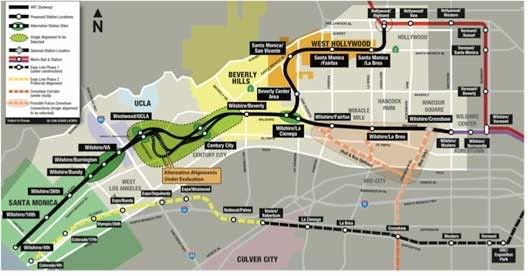
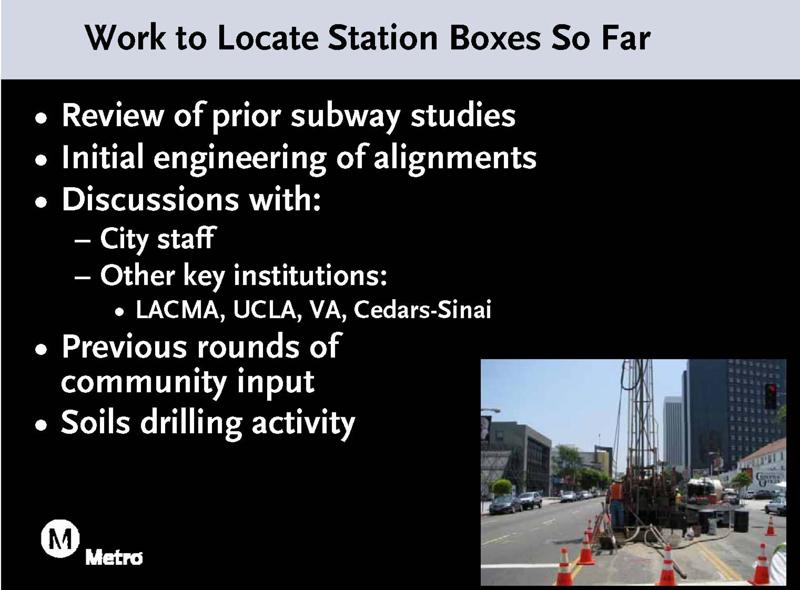
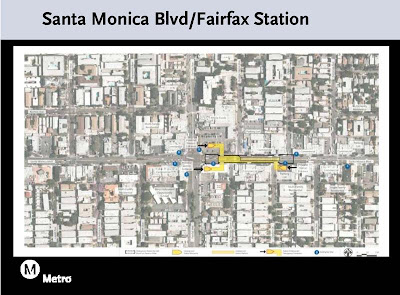
Here are thumbnails of slides you should look at regarding the Westside Subway Extension Station Information Meetings that were held back in November 2009. These are interesting because these meetings were about the nuts and bolts of designing subway stations.

First, here is the dream we are all hoping for for the Westside Subway Extension of the Purple Line with a West Hollywood alignment included (colloquially referred to as the "Pink Line"):


However, this is what is likely to move forward for Federal funding request at this time, in part because this is the portion that will be matched with funds approved by Measure R:


We need to continue to lobby Metro to build the Santa Monica Blvd alignment, at least in the long-term.

However, with that understood, if the Mayor's 30/10 plan is financed by the Federal government, we may be riding this Purple Line extension within 10 years.

The sooner the Purple Line gets to Westwood and the V.A., the sooner we will see a rail alignment for Santa Monica Blvd.

Please find below the relevant slides to station design that were presented back in November. Enjoy!