Tuesday, May 1, 2012

Calling for a transit-only lane on Santa Monica Blvd. - Sunset Blvd. between Santa Monica and Union Station

I consider myself the biggest cheerleader of bringing Metrorail to the West Hollywood environs.  And with luck, the northern extension of the Crenshaw/LAX light-rail line will be routed to Hollywood via West Hollywood and its neighboring areas.

However, we shouldn't forget surface transit.  Even with Metrorail, major corridors throughout Southern California are also going to need transit-only lanes allowing for speedy service for buses and modern streetcar trams to connect people to the "first/last mile" of the their journey.  We will need a full network of transit-only lanes all over the county (in addition to bicycle lanes).

Here's a sample pic of what this might look like.


As part of this, in addition to the Purple Line expansion as part of the Westside Subway Extension, there is currently a project to bring bus rapid transit to Wilshire Blvd.

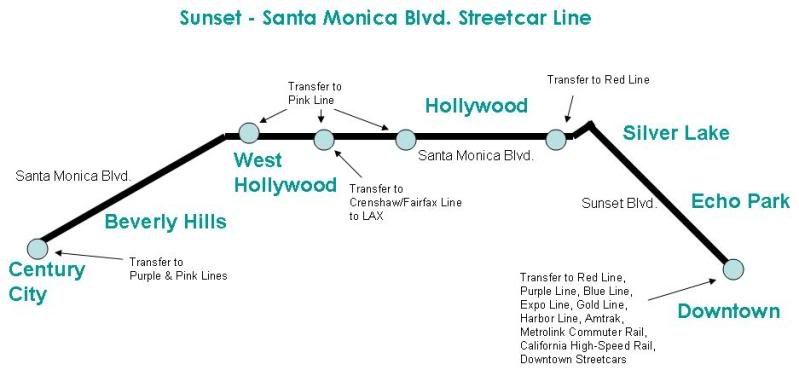
I will be the first to stand up and call for a Santa Monica Blvd. transit-only lane between the ocean and Sunset Junction, further heading downtown to Union Station.

As a transit-only lane, it could potentially run modern streetcars quickly and efficiently.  Just imagine...


Now my willingness to take lanes away from cars to allow for more mobility for transit and bicycles may doom any chances I might ever have to get elected to political office in Southern California or it may not.  (No, I am not a candidate for anything.)  But the golden era of cheap gasoline and the single-occupancy automobile in southern California is LONG behind us.  Even if we "drill, baby, drill", $2/gallon gasoline is gone forever.  It's a global market and China and India are not going to stay in the third world so that we can drive our SUVs cheaply across the streets of  Los Angeles.  Therefore, we need to consider practical ways to expand mass transit mobility affordably like any other world class metropolitan region.

So let's bring a transit-only lane to Santa Monica Blvd. while we continue to advocate for Metrorail.


A Los Angeles eye view of Toronto Transit

Recently I had the privilege of being in Toronto, Ontario, Canada.    Toronto is an amazing city with great people, great food, and a great transit system.  In fact, like Los Angeles, Toronto's is in the process of a huge expansion of its mass transit system -- truly a world class city unfolding.

Though attending a business conference, I had a little free time and I used it to sample Toronto's transit system and to see how Toronto's current system could inspire user-friendly changes to our own expanding system.

I took pictures.  (My apologies for any blurry pics, I make NO claims on being a good photographer.)


Here is a subway entrance and something you rarely see in Los Angeles -- an actual transit shelter for streetcars and buses.


This streetcar and bus stop has a shelter with a CURRENT systemwide map on it.  Why can't we have transit stops with covered shelters and/or current transit system maps posted on them to make it easy and convenient on riders.

Here was my day pass in Toronto.  It works like a scratch lotto ticket.

Here is a daily free newspaper "Metro" that people pick up to read in transit stations.  There was also a Metro free daily that I read on the London "tube" when I lived there.

Here is a fully underground grocery store.  Makes for very convenient shopping on the way home.

Never underestimate the value of CURRENT system maps as well as station area maps to help riders.

This subway car has a sign that points to which side of the subway car will have the doors open.

Here is an electronic map in the subway car that points out where you are in the system and what the next stop is -- very convenient!

Notice the television screen in the subway with accurate up-to-date information

Another tubular type of platform -- very London-esqe.

And because there are people who use paper day passes even with turnstiles, there will need to be human monitors at subway entrances to allow those people through.  (Note to Metro that is considering locking subway entrances -- you will still need to have human monitors at the stations for regional paper pass holders like me.)

Nice how subway entrances are located within office complexes.  When the Century City station on the Purple Line is built as well as a future 5th/Flower subway station infilled on the Regional Connector, think of the possibilities.

Whoops.  This subway station had multiple entrances only this one did not have a human monitor.   Those entrances need to be labeled.

Note this nice weather protected entrance to the subway station.  It gives you a chance to open your umbrella before going outside or closing it before you head down the escalator.

One of the things I miss the most from New York and London subway systems are the buskers.  Why not have quality musicians playing in the system for tips?

Look that something you hardly ever see anymore -- pay phones, plus a lotto stand in the subway.

Look, a convenience store within the subway station -- for buying a newspaper or picking up breath mints prior to that important business meeting.

Here is the inside of a spacious subway car.  The Red/Purple Line cars in Los Angeles are poorly designed  The middle seats should be back-to-back to give a more open feeling.

Look at the clear bag trash receptacles that include recycling and a machine to get your transfer (which Metro doesn't do anymore.)

The downtown subway stations connect to full service malls underneath office buildings.


Here is a subway entrance with two service windows and several turnstiles.


Here are the Toronto equivalent of Zipcars.

What?  You thought gasoline was $1.30 a gallon in Canada?  Nope.  That's per liter.  The "drill, baby, drill" fools think that we can drill our way back to $2 a gallon gasoline.  It is a global oil market and China and India are not going to stay in the third world so that suburban/exurban residents can drive gas guzzling SUVs in America cheaply.

Here is a Toronto streetcar that comfortable rides in traffic at grade.  (Think of how much quicker they would be if these were transit only lanes.)  Modern streetcars are coming to Los Angeles in just a few years.  Woo hoo!

Personally, I think the overhead wires and tracks of the streetcars aren't blight.  They are part of the ambiance of the city.

As part of its transit system, Toronto allows you to rent a bicycle.  All part of the convenience of a transit friendly city.

The one thing I didn't have time to do is ride the ferry to the Toronto City Airport.  Toronto is planning rail links to Pearson International Airport.

Metro can adopt some of these amenities.  Your local city or neighborhood council can adopt some of the others.  Public-Private Partnerships are possible.

Now, sometimes as I discuss the growing transit network in Los Angeles I will hear someone say, "but what about my automobile?  I love my car and don't want to to give it up."  To which I say, "Uh, no one is asking you to.  Keep your car.  There are millions of others who want to have an alternative."  And Toronto, like New York and London and Tokyo and other cities with world class transit systems, there are also millions of automobiles as well.

So here's to Toronto.  I look forward to witnessing the unfolding expansion of transit both there and back here in Southern California.



Wednesday, April 18, 2012

Be careful for what you wish for, Beverly Hills

As a strong supporter of Metro's Westside Subway project, I also support the Century City stop being at Constellation and Avenue of the Stars, in the center of the community.

As rail runs under the Pentagon, I'm not too concerned about tunneling under Beverly Hills High School.  I have lived in New York and London where tunnels safely went under all kinds of buildings.

That said, if the Century City station on the Purple Line extension were on Santa Monica Blvd. instead of Constellation, wouldn't that create tremendous pressure to sell Los Angeles Golf Course and redevelop the north side of Santa Monica Blvd. into "Century City North", and pour even more traffic onto Beverly Hills?

As someone who balances idealism and cynicism, I have to wonder:  Are there any people calling for the Metro Purple Line stop to be on Santa Monica Blvd. because they secretly WANT to develop Century City North and are hiding behind the Beverly Hills High School "safety" issue?  Obviously the Purple Line extension should be built as safely as possible.  But how much of that opposition to tunneling under Beverly Hills High School has another hidden development agenda or behind it, or a consequence of it?

Be wary of the law of unintended consequences.  It would be ironic if Beverly Hills got what it wished for only to see Century City North developed.

Tuesday, April 17, 2012

Should the Hollywood bus terminal be at the Highland station or the Vine Station?

Here is something that has confused me.

The suggested northern terminals for any northern extension of the Crenshaw Line and the original Santa Monica Blvd. alignment proposal of the Westside Subway extension has been the Hollywood/Highland station.


This got me thinking about the current bus terminal for the forced transfer between the 212/217 to the 180/181 at Hollywood/Vine.  These buses probably terminate at Vine because there is a designated parking area for buses to wait and for drivers to have their breaks (which is important) near Hollywood/Vine.  (Put aside the question for now about whether there should even be a forced transfer there.)

However, shouldn't for convenience sake the 180/181 go west to Hollywood/Highland to allow for easy transfers to the 156/656?  Is the heavy density area on Hollywood between Highland and Vine really "duplicated" by that short extension?

What is the center of Hollywood anyway?  The "Walk of Fame" intersection at Hollywood/Vine was the cultural heart of Hollywood before the (formerly named Kodak) Theatre was built at Highland.  Shouldn't possibly the Hollywood/Vine station be considered as a possible northern terminal for any rail line ending in Hollywood, also since that is where the bus terminal parking is?  (Granted, at that point it is probably cheaper to somehow move the bus terminal parking near Highland if an expanded station is being built there to accommodate another rail line -- or even include a bus terminal as part of the design of the expanded station.)

This brings up the seemingly unpleasant but necessary discussion of urban and transit planners to fulfill the need for resting buses to park somewhere and for bus operators to have a safe place with appropriate facilities to take their breaks.  So where should an appropriate Hollywood/Highland bus terminal be?

And since we are talking about bus lines on Hollywood, there are actually several bus lines that run or terminate on Hollywood Blvd.  Isn't Hollywood between Highland and Western a natural street for a transit-only lane?  I certainly think so.

Monday, April 16, 2012

The "Public Option" in Health Care is Alive and Well in California

Every once in while I like to comment on non-transit issues on this blog.  In this case, I'd like to take on health care in California.

One of the components of the Affordable Health Care Act (a.k.a. "Obamacare") that people are missing is how much latitude each state has in implementing it. During the development of this legislation advocates for a national single-payer system (a.k.a. "Medicare-for-All") were not even allowed to come to the table to make their case.  Even the compromise position, giving everyone access to a public health insurance option, tragically couldn't get past a Senate filibuster.

However, thanks to this legislation, individual states can follow Vermont's example and pursue single-payer health care or at least place public health insurance plans on their state's coming health insurance exchanges as a state "public option".

Now I still from a policy standpoint prefer Medicare-for-All or single-payer health care.  Twice single-payer health care has passed the California state legislature only to be vetoed by Governor Schwarzenegger.  Now that there is a Democratic Governor who would be expected to be favorable to the legislation, SB810 is unfortunately stalled in the legislature thanks to insurance industry lobbying.

Several California counties have public health plans already, and California is likely to even have a choice of public health insurance plans as progressive counties like San Francisco and Alameada are looking to putting their public plans on the statewide exchange.

Read this Article: The Public Option is Alive and Well in California


The good news for health insurance reform activists, is that it looks as if in California we will at least have one or more public options on our state's coming health insurance exchange.  Even if "Obamacare" is struck down by the Supreme Court, the California state legislation creating a state health insurance exchange still stands.

The question now becomes, are county plans on the statewide exchange accountable to county Boards of Supervisors the best way to give access to public health insurance options?  Should a statewide public plan accountable to the Governor and the Legislature be include on the state exchange?  Could Medical be turned into a statewide public option open to everyone?

Watch this space for news about this issue unfolds over the next two years.

Thursday, April 12, 2012

Is a Sepulveda Pass light-rail line salvageable?

Two days ago I posted my fears and discouragement that the Sepulveda Pass transit corridor project was sadly looking at first glance like it would be an inadequate bus project, rather than the light-rail line between Sylmar and LAX many of believe it should be.

The question remains, is a light-rail project through the Sepulveda Pass still possible?

Jerard Wright, current Sierra Club Angeles Chapter Transportation Committee Co-Chair and former Vice President of the Transit Coalition believes it is.  Here are his thoughts about this (shared with his permission):


I think its salvageable -given that its early in the process- but the key thing is being realistic on funding.  

Don't assume Federal New Starts on this with 30-10 or America Fast Forward programs because those are committed to Purple Line to Westwood and Regional Connector projects at this time. If it shows that it has Federal New Starts potential, then that may delay the project delivery date as it will need to go through another cycle of New Starts.

My thoughts are focus the bulk of the rail energy on the Sepulveda Pass corridor from Orange Line to Expo Line with or without the tunnel parallel to the pass, stretch that $1B+ to link up with as many activity centers as possible so that you can get some stronger ridership data.
Use the Public-Private Partnership ideas on some of the station area planning/developments such as Sepulveda Orange Line station, Ventura Blvd (Sepulveda or Van Nuys), Sepulveda/Pico Expo Line station maybe even UCLA/Westwood Village station to bridge gaps in funding. So that more money goes towards the route infrastructure and less of it goes to the stations themselves.  

The key is, given that this could be LRT, Could this corridor take an initial San Diego trolley approach here a simple no-frills design and infrastructure? I don't know how much construction ROW or easements will be left after the 405 HOV widening project but I would suggest building shallow tunnels and trenches under these easements- if they can- where the elevation shifts and differs.  

I wished Metro spent a little more $$$ on the 405 HOV project to go towards a future ROW for such a transit project as this would have saved money in the long run.  

The Van Nuys Corridor in the long term visioning should be rail, however any sort of infrastructure beyond a TSM would make it difficult to get a future rail corridor. Should the approach be pushing for TSM on this leg? TSM could possibly do the same things as the lanes (such as better signal pre-emption & synchronization on both the Local and Rapid corridor buses and consolidation & relocation of bus stops to expedite boardings which improve operating speeds)  at a lower cost then BRT and saves more of the money needed to push a rail transit corridor north following the intended vision.

What do you think?

Expo Line is a Go!

I was fortunate to be invited to ride a test run of the new Expo Line yesterday.  The first half of this line opens up to the public on April 28th.  It is just beautiful, especially the way the line integrates with USC.  The second half to Santa Monica opens up in a few years.

Here is a pic that I took with my mobile phone that is quintessentially Los Angeles:


At the Western station, on the southeast corner of Expo and Western, there is a gas station that has a vegan bakery.  This is why I love Los Angeles.

I was able to join this test run thanks to Eli Lipmen of AJC (American Jewish Committee), where in full disclosure I am currently working.

AJC is a strong supporter the Expo Line, of Measure R and of Mayor Villaraigosa's "30/10 Plan".

According to Eli Lipmen, AJC Communications Strategist, “AJC is committed to public transportation in the City of Los Angeles because we need to break our dangerous dependence on oil produced by hostile countries. Measure R, the 30/10 Plan, and more public transportation options in Los Angeles will reduce the amount of fossil fuels being used in the region while also reducing traffic and emissions that can cause respiratory diseases. It is a win-win-win!”

Here is a view of Century City from the platform at the new LaCienega station on the Expo Line:


We are halfway from Downtown to the beach.  Now let's work together to complete the second half of the Expo line all the way to Santa Monica as soon as possible.  While we are at it, let's get the Westside Subway extension to West L.A. and the Crenshaw/LAX line extended to West Hollywood and Hollywood/Highland.

By the way, since the color of this line on the map is light blue, why not call it the Aqua Line since it will eventually be going to Santa Monica anyway?