Showing posts with label transit. Show all posts

Wednesday, July 7, 2021

"I want to make Metro the first choice in transportation that people think about" - Metro CEO Stephanie Wiggins

At Metro's State of the Agency presentation, new CEO Stephanie Wiggins uttered some powerful words that gave me goosebumps.:

"I want to make Metro the first choice in transportation that people think about. In great cities around the world: London, Paris, New York, D.C., taking mass transit is normal and expected. In those cities, it's just what people do. In those cities, public transportation is their obvious choice. I want Angelenos to think that way."


This is a bold and powerful statement.  It's the vision of Los Angeles public transportation that I have always had -- where it is not seen as merely "welfare mobility for the poor who would surely buy cars if they could", but as a viable, primary, and environmentally sustainable means of transporting oneself everywhere one needs to go.  I want the mobility experience I had living in New York and London, right here in Southern California.  I don't expect everyone to make that choice, of course.  However, it should be an option that is thought of as "normal" and "reasonable" for a world class metropolitan County like Los Angeles.


More power to her.  She has my full support. 

Wiggins also mentions the importance of equity and compassion, and that law enforcement will not the first resort in dealing with homelessness.

I really appreciated her honest admission that the rollout of NextGen last week could have been better,:  "We have learned some tough lessons over the last week."  She promised more accountability, transparency, and clearer communications about fare collection and the NextGen rollout.

Also speaking on the program was incoming Metro Chair, Los Angeles County Supervisor Hilda Solis.

I encourage you to watch the whole program.  Wiggins begins her remarks at minute 34:


Wednesday, June 30, 2021

How Metro Can Do Better Next Time

This is not a bash Metro post.  I believe in Metro's mission, want Metro to succeed, and for Los Angeles County to have a world class transit system on the level of New York, London, Paris, and Tokyo.

But let's be honest.  Metro's rollout of its Service Changes on June 27, 2021, and its NextGen Service plan, was poorly executed.  Metro's new CEO Stephanie Wiggins admitted as much in a note on fares, enforcement, and service changes.  It is welcome to see Metro publicly acknowledge there was a problem.

Kenny Uong, who is quickly making a name for himself in Southern California for his transit advocacy and enthusiasm blogged on Twitter his experience seeing confused riders all over the system, who had no idea that the service changes were happening or what they were, and bus stops still having old signage.  


As of writing this post, Metro still had old bus service maps from 2017-18 on its website, which is certainly not helpful for anyone trying to figure out how to navigate the current system today.  Not everyone riding Metro has a smart phone or can easily use an app like Transit or Google Maps. 

Metro had also issued a confusing "TAP where you can" statement, with bus operators quoting fares that riders were unprepared for paying.  


Fortunately, Metro provided clarity today.


What we should have been doing this week is celebrating Metro's more frequent service on certain lines and the rollout of the new bus lanes on Alvarado.  Unfortunately, this was all overshadowed for many riders, especially for those who depend on transit as their primary source of mobility. 

However, this can be a learning opportunity.  Here is how Metro can do better when rolling out service and fare changes in the future:

  • New systemwide maps should have been designed and publicly released prior to enacting service changes. People need to see how the system works as a whole. More frequent service should be colored differently than less frequent service. Create an "owl service" map too.  San Francisco MUNI posts current service maps at all of its bus shelters.  Why can't Metro do this as well?  (This is also free publicity as pedestrians walk past the maps and can see all of the places that the bus system goes.)


  • Bus stop signage should be changed prior to enacting service changes, with flyers warning about the start date at all affected bus stops.  As Alissa Walker tweeted, "If this was a freeway the signage would have been replaced overnight."

  • Metro needs clarity on fares and to issue advance notice of fare changes. Either we have them or we don't. Metro can opt not to enforce fare collection, but be clear about the policy.  As Metro buses can broadcast messages like, "Service changes begin ______", or "Masks are required", or "Go Dodgers!", buses could also broadcast messages like "Fares to resume on ______".
    Also, for convenience, TAP readers should be posted on the left of the front entrance of every bus to speed the boarding process for everyone.

In short, have everything in place for the ridership BEFORE enacting service changes or fare increases.

It is truly wonderful that Metro is expanding rail service throughout the County which has my full support.  Now let's also give its bus system the upgrade its ridership deserves, like transit lanes on all major corridors.  


Sunday, August 2, 2020

A Proposal for a New Entertainment Shuttle for Hollywood & West Hollywood

In West Hollywood, pre-pandemic, West Hollywood had two free entertainment shuttles which ran Friday and Saturday nights, the Pick Up Line and the Sunset Trip.  (The Pick Up line also ran on "Sunday fundays" and certain holidays.).

The advantages of a free shuttle service serving nightlife are obvious.  It reduces the amount of traffic in the area, reduces drunk driving, reduces the demands on parking, and provides more customers to businesses in these districts.  These free shuttles ran old trolley cars and played hip music and have a fun atmosphere too them.  You can see their respective routes below:


Eventually, whenever things re-open again at some point in the future, and nightlife returns again, West Hollywood can bring back entertainment shuttle service.  Unfortunately, post-pandemic, there are not funds to operate both shuttles.  The Pick Up Line will return first when things re-open again in the future.  

A proposal I have is to modify the Pick Up route, so the western turn around also serves a part of Sunset Blvd.  This will take people up the hill to part of the western Sunset Strip and provide shuttle service to places like the Roxy, the Whisky-a-Go-Go, the Rainbow Room, and the Viper Room, among others, as seen below;


For future planning, I want to propose something bigger and grander involving both Hollywood and West Hollywood.  A "Super Entertainment Shuttle" if you will.  It would serve the Rainbow District, the Sunset Trip, and currently unserved "Theatre Row", as well as taking people to clubs in Hollywood and the "B Line" ("Red Line") Subway.  I envision both a clockwise and a counterclockwise loop.  Please see below.


Two notes:  (1)  I'm currently envisioning the entertainment shuttle heading north from Sunset to Highland rather than LaBrea, because Hollywood Blvd. is often a standstill between Highland and LaBrea on Friday/Saturday nights;  (2) Also, those numbered blue dots are mileage markers, not proposed stops.  The whole loop is slightly under ten miles.   

Granted, this shuttle would require cooperation between both the Cities of Los Angeles and West Hollywood, and it will be months before all of these types of businesses re-open.  But we plan for the future today.  

Imagine someone taking the Red Line to Hollywood, to then catch the shuttle to see a play on Theatre Row or a set at The Comedy Store; and then heading for a drink at The Rainbow Room, or Mickey's; and then head back to the subway, having left the car at home.

What do you think?

Wednesday, July 22, 2020

Revisions to Metro's NextGen Bus Plan

Here is the good news.  After community outreach, Metro has made some revisions to its NextGen Bus Plan, and Line 218 has been saved, albeit in truncated form between Ventura Blvd. and Santa Monica Blvd.  Personally, I'd extend it from the Orange Line to Wilshire Blvd. (Purple Line), but I am grateful to see it survive it at all.


To review, the NextGen Bus Plan essentially takes the Rapid and Limited bus lines and combines them with their respective Local bus lines to create a more frequent overall service.  This approach has worked in improving ridership in other regions.  Here are the lines most relevant to West Hollywood:

Rapid 704 and Local 4 are combined into new frequent Line 4


Limited 302 and Locals 2 and 200 are combined to form frequent Line 2.


Rapid 705 is combined with Local 105 into new frequent Line 105.


Limited 312 is combined with Local 212 to create new frequent Line 212.


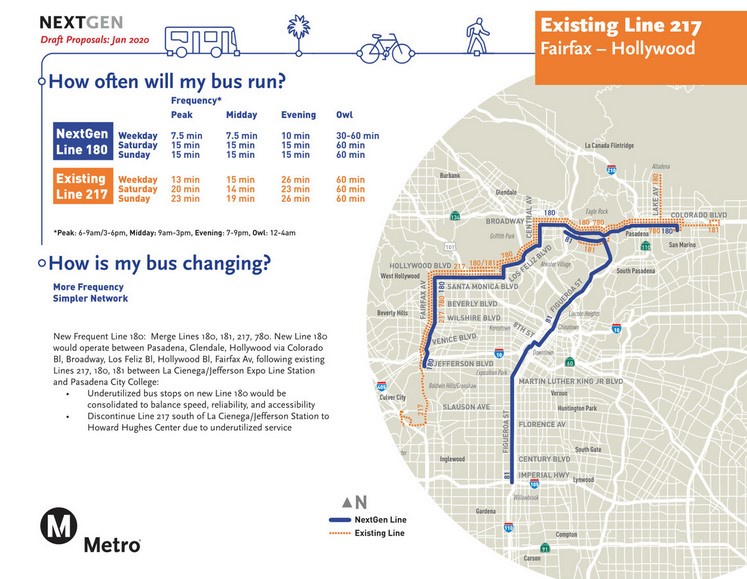
The change I find most fascinating is the merging of Rapid 780 with Locals 217, 180, and 181 into one new powerhouse frequent Line 180.


"In my opinion, this new frequent Line 180 is really going to need bus lanes on Hollywood Blvd. between La Brea and Vermont to work operationally."  Hollywood Blvd. is being considered for a makeover anyway, so now is the time.  So many bus lines start and finish on Hollywood, coming and going from all directions, that bus lanes on it make practical sense to me.

Here is one for my friends in Malibu.  Line 534 turns into Line 134 and has more frequent service.


I look forward to seeing the NextGen Bus Plan put into operation so that we can enjoy a more frequent service.  I've shown the major plans affecting West Hollywood, but you can see all of the NextGen Plan Updates by clicking here.

Thursday, July 25, 2019

What is Metro's NextGen Bus Study's Regional Service Concept

Metro has set out to design a new bus network that is more relevant, reflective of, and attractive to the residents of LA County, which it has branded as the NextGen Bus Study. This type of overhaul and updating of the bus system happens about every few decades. It's important to keep the bus network relevant and upgraded to represent current demand and travel patters.  Hopefully this will help with increasing Metro bus ridership as a similar redesign recently helped ridership in Austin, Texas.

Metro has completed Phase 1, its "Research and Analysis" phase.  Based on the data collected and a vast amount of outreach, Phase 2 is now presentation of Metro's "Regional Service Concept".  Phase 3, after the approval of the "Regional Service Concept", will be development of the "NextGen Service Plan", expected in early 2020. Phase 4 will be "Implementation" of the plan once approved.

So what is this Regional Service Concept that Metro is proposing to base design of its new service plan?

According to Metro, "Together with your comments, the Regional Service Concept is guiding the NextGen bus service planners as they examine every Metro bus line and bus stop to determine the best system redesign possible."  This phase will defines the goals and objectives of the new bus network, and will include measurements of for success of the new network, route and network design concepts based on public input and data analysis, a framework for balancing the inevitable tradeoffs that this new plan will require, and, of course, Metro’s Equity Platform considerations.

In 2018, the Board adopted Metro Vision 2028 as the agency’s strategic plan. Metro sees the NextGen Bus Study as addressing one of the plan's top goals: "Provide high quality mobility options that enable people to spend less time traveling."

The Concept lists three key factors to developing the new transit network:
  1.  Transit Propensity - Identity the areas where the propensity to use transit is the greatest, by examining the market segments of transit customers (transit reliant riders, commuters, and discretionary riders) and the intensity of demand by population and place (prospective ridership generators);
  2.  Existing Service Performance -  identify and optimize the most productive segments of the existing bus network which matches current transit demand (what's already working well);
  3.  Service Environment - Removing land use barriers to successful service, and implementing transit supportive infrastructure (such as transit-only lanes).
In particular, check out "Attachment E" (pages 151-157) of the Concept for signs of what bus lines Metro scores as performing well in the current network, and what lines it scores as underperforming.

I expect people will be very interested about any proposed changes to their current transit lines, for many people their transit access and reliability can determine their mobility, their economic prosperity, and social/cultural opportunity.

It will be months before we see the new proposed NextGen Service Plan.  While we are waiting, check out the NextGen Bus Study Data Center where Metro has granted access to an amazing ocean of transit data analysis, more than enough to keep any transit fan occupied until the NextGen Service Plan comes out by early 2020.

For a Ridership Data Tool that "allows you to explore monthly ridership stats, line level trends, and historical information for every line in Metro's system," please click here.

For a Trip Density Per Census Tract Map that displays volumes of daily trip origins per census tract, including both transit trips (recorded by TAP data) and overall trips (car, transit, etc.), please click here and zoom in/out.

For a Corridor Segment Performance Map that "displays which segments have the most ridership and are the most productive," please click here and zoom in/out.

For a Frequency Map that "displays how often buses are arriving at stops for segments of each route, with the red lines showing they most frequent segments," please click here and zoom in/out.

For a Trip Length Distribution Map that "displays how far riders typically travel along the corridor based on their starting point, with darker red dots indicating longer trip lengths," please click here and zoom in/out to click on a starting point to display the average length.

For an Origin-Destination Patterns Sliding Map that "displays the pattern of where current transit riders are starting and ending their trips," please click here and zoom in/out and slide back and forth to compare origins versus destinations.

For a Seated Capacity Map that "displays how full, on average, the buses are on segments of each route. The darker the color represents segments of a route where buses are fuller". please click here and zoom in/out..

For a Stop Level Ridership Map that "displays the level of activity at each of Metro’s bus stops, with the red dots representing high activity, with detailed information on the number of boardings, on and off, by simply clicking each dot/stop," please click here and zoom/in out.

For a Transit Propensity Map that "shows you the areas where the propensity to use transit is the greatest," please click here and add the layers of demand data you want while zooming in/out.

Phew!  That is a lot of data.  I cannot wait to see the new proposed service plan.

Wednesday, July 24, 2019

Please Give Us Shade... (No, Really.)

Last night I was waiting for a bus at Wilshire Blvd. and 26th Street at a major bus stop that serves local and rapid buses, and here is what I saw:


Notice something interesting?  Here is another view.


People are not sitting in the hot sun in the pretty, artistic seating.  They are standing in the shadows of poles and trees.  This is how too many people wait for the bus in Southern California.  If you are a big and tall guy like me, the pole may not be big enough.


My question is. why isn't there a bus shelter?  Why isn't there shade?  It makes for a very uncomfortable wait.  When it rains, and we know from this year that it actually does rain in Southern California, we basically get wet.

Here is an example of a London bus shelter design  I love -- that has shade, seating, a map, a digital screen, and is ADA compliant -- that I would like to see all through Southern California.


Isn't this pretty?  Why don't we have adequate bus shelters throughout much of Southern California?   Don't blame Metro for this.  The quality (or lack thereof) of bus shelters and bus stops is largely the responsibility of  the cities in which they are located.

Also, are bus stops designed based on how aesthetically pleasing they look or for the benefit of the transit user?  Ideally both, but functionality is essential.

By pointing out this stop, I am not ragging on the transit-supportive city of Santa Monica here, or its terrific Big Blue Bus system.  This one stop is just an indicator of a county-wide deficiency.  I should also add that my city of West Hollywood is currently upgrading its bus stops and shelters, which is terrific.  But, if you don't have adequate bus stop shade where you live, work, and play, then go to your city's Transportation Commission meeting, or even its City Council meeting, and insist on quality bus shelters that offer real shade from the sun and rain during public comment. 

As I stated in my last blog, there are two basic views of public transit and its components that I run across:

(A)  "Public transit is method of moving masses of people of all classes and demographics conveniently from place to place, increasing mobility, cultural opportunity, and economic prosperity, while helping the environment and quality of life for all by providing an reliable alternative for people who would otherwise exacerbate traffic problems by driving more cars on our already clogged roads."

(B)  "Public transit is a form of "transportation welfare" meant to provide a subsistence level of mobility to poor people who would, of course, get their own automobile as soon as they have the means and opportunity."

Too many people think of transit in Southern California solely as (B) and therefore don't see the problem here.  If you only think of transit as just transportation welfare for poor people who would rather be driving a car, then you probably don't care about investing in or improving the system, or the experience of the transit rider. 

Having lived in New York, and other Metropolitan cities, I envision transit as (A), and that is why I seek to improve it for everyone in the Southern California region, because I see everyone as a potential user.  I absolutely reject the limited, outdated idea that "this is Southern California and we have a car culture, so mass transit will never work here."  Millions of people already use the system we have and voters passed Measures R (2008) and M (2016) to improve and expand our system.

One person has told me dismissively, "if we build transit shelters, the homeless will simply camp out in them".  Not if we adequately address the issue of homelessness, which is a whole other blog topic.  I also reject the idea that the severe issue of homelessness in Southern California should limit or be dumped on our transit system and its components.  Let's solve BOTH issues.

I don't write this blog post to complain.  I truly believe in mass transit as a public good, and a public good right here in Southern California.  If there is an amazing bus shelter in London, we here deserve no less.  If there is any amazing transit feature (signage, maps, technology) in any other city around the world, Los Angeles County deserves it too.  This a world class metropolitan capital of culture and commerce and we should have a transit system that is top of the line, and in the front of innovation -- not as an afterthought because, of course, we'd all rather be driving an automobile.  Let's have a world class transit system for everyone worthy of a City and County of Angels.

In order to have the robust, user-friendly rail and bus transit system we all want, please give sunny (and sometimes rainy) Southern California adequate shade at all its transit stops.

-----

Edited to Add:  Please read this excellent Places Journal essay on "Shade", which explains who in Southern California gets shade (and who doesn't) and why.  Please click here to read.

Monday, July 22, 2019

Homelessness and Public Transit in Southern California -- What is the answer?

Homelessness is not only a housing issue, but a public transportation issue too. Here is shiny new bus stop seating right across the street from West Hollywood City Hall that no paying or prospective transit passenger on their morning commute can use because it has been taken over by a sleeping homeless person.


Other scenarios people who use transit are all too familiar with:
- A homeless person takes up multiple seats with their belongings forcing other people to stand.
- A homeless person either under the influence of alcohol/drugs and/or is mentally ill is disruptive and threatening to other passengers.
- A homeless person who hasn't bathed in several days makes for an unpleasant ride for everyone else around him on the bus.

This post is not meant to be a general complaint about "the homeless".  I have tremendous compassion for homeless people.  We are speaking of  flesh and blood human beings here who deserve our consideration and respect and help.

However, allowing homeless people to take over public transit infrastructure hardly seems fair to the paying transit passengers who deserve safe, clean, comfortable rides.  (If you are someone who drives a single-occupancy automobile thinking, "Well, what's the problem?  I'd stand for a homeless person,"  I'd ask you in return, "how often do you have to?"  It's easy to invoke someone else's inconvenience in the name of one's own compassion.)

When increased homelessness spills onto the transit system and its infrastructure, it suppresses transit ridership because it makes the journey less comfortable and for some people less safe.  So then some people who can afford to opt out of the system, do.  I don't have any raw numbers, but I certainly have an endless supply of anecdotal evidence from people who tell me this is one of the reasons they personally avoid using transit or have stopped using transit.

There are two basic visions of public transit I come across:

(A)  "Public transit is method of moving masses of people of all classes and demographics conveniently from place to place, increasing mobility, cultural opportunity, and economic prosperity, while helping the environment and quality of life for all by providing an reliable alternative for people who would otherwise exacerbate traffic problems by driving more cars on our already clogged roads."

(B)  "Public transit is a form of "transportation welfare" meant to provide a subsistence level of mobility to poor people who would, of course, get their own automobile as soon as they have the means and opportunity."

Too many people think of transit in Southern California solely as (B) and therefore don't see the problem here.  Having lived in New York, and other cities, I envision transit as (A), and that is why I seek to improve it for everyone in the Southern California region, because I see everyone as a potential user.

However, it is increasingly clear to me that unless we do a better job of addressing the issue of homelessness in Southern California, our best efforts to improve transit here are going to be inhibited.  In essence, those of us who are transit advocates need to become homelessness advocates out of necessity.

What is the scale of the homelessness problem in Los Angeles?  The Los Angeles Homeless Services Authority (LAHSA) estimated 59,000 people on the streets of Los Angeles County.  That is truly a heartbreaking number.

So how can we solve this?  The City of West Hollywood addresses homelessness with a multi-disciplinary, multi-agency, collaborative response.   The City also has a five year plan to address homelessness.

However, no one city or one community can solve the issue of homelessness for the whole region.  All of us in Southern California need to do our part, and every community in Los Angeles County needs to do its part too.

In March 2017, Los Angeles County voters passed Measure H to raise money to address the issue of homelessness.  Los Angeles County also has 47 Strategies to Address Homelessness.

What do you think?   Constructive and compassionate solutions welcome.

-----

Edited to add:  A Social Services Manager from the City of West Hollywood has informed me that if we see a homeless community member in West Hollywood who we would like to help, please call WeHo’s homeless concern line at 323-848-6590. They will meet the homeless community member where they are at and offer services to help get them off the street. 

Metro Los Angeles has a homeless task force.  An article about how Metro is expanding its homeless services appeared in the Santa Monica Daily Press on June 1, 2019.  Please click here to read it.  


Tuesday, July 2, 2019

A Look at Metrorail's Crenshaw/LAX Northern Extension Project to West Hollywood and Hollywood


Metro is currently studying extending its coming Crenshaw/LAX light-rail line, which is expected to open year, further north to Mid-City, West Hollywood and Hollywood.  This Northern Extension would provide a mighty north-south rail transit corridor connecting four rail lines (Green, Expo, Red and Purple) -- five if you count the Sepulveda Transit Corridor Project under study.

Following this Feasibility/Alternatives Analysis of five potential alignments for the Northern Extension (seen below), Metro will now preparing an Advanced Alternatives Screening Study to gather public input and further analyze the five alignments to help determine which alternatives will be studied further in a subsequent environmental analysis.


Measure M allocates $2.24 billion to the project, with a groundbreaking date of 2041 and project completion date of 2047. Metro is conducting this study now as there are efforts underway to identify funding to accelerate this schedule.  ALL projects look for additional funding to speed construction.  Please do not be daunted by the currently scheduled completion date.   That can and will be moved up.  This project can certainly be made shovel ready soon.

Metro has been holding a series of community meetings about this project.  I went to the first one and it was exciting to see a room full of people eager and excited for a Metrorail project to be built and built soon.

One of the things I learned is that Metro expects this line when completed to be one of the heaviest used light rail lines in the country, with its connection to five Metro rail lines, LAX, Hollywood, West Hollywood, and major bus corridors.  That sounds like an excellent reason to find the funding to speed up construction, doesn't it?  Perhaps even by the Olympics in 2028.


One of the things mentioned by Metro is that the further west the proposed alignment, the more job centers that are accessed by it.  When I inquired if the alternative analysis had studied nighttime ridership, they mentioned it had not.  We know that this area has a large number of nighttime riders and employment.  Any late night ride on a crowded 4/704 bus will tell you that.  Hopefully, Metro will choose alignment A or B.  C is another meritable choice.   My personal opinion is that LaBrea is too far east and misses too many ridership generators such as The Grove, Cedar Sinai hospital, and the Beverly Center.  Also, based on these numbers in the Feasibility Analysis I would be surprised if the Vermont alignment makes it any farther in the studies for this project.  There is, however, a separate Vermont Corridor project underway.

Metro has one more community meeting scheduled for this phase of the process -- Thursday, March 28, 2019, 6 – 8 p.m. West Hollywood Library, 625 N. San Vicente Blvd. West Hollywood, CA 90069. Accessible via: DASH, West Hollywood Cityline and Metro bus lines 4, 10, 16, 30, 105 and 704. There is limited street parking and a parking lot available.

EDITED TO ADD:  I attended the March 28th meeting and heard the following:  "The Fairfax alignment accesses twice the number of jobs as the La Brea alignment, and the La Cienega / San Vicente alignments have twice the number of that."

Please check out Metro's website for the Crenshaw Northern Extension at metro.net/crenshawnorth and if you cannot attend, please let Metro know by email that you support this project and which alignment you support (hopefully "A/B" or at least "C") at crenshawnorth@metro.net.

Originally published on March 27, 2019
  

What I Learned at the Sepulveda Transit Corridor Project Community Meeting

Transit advocates have been dreaming of a public transit rail line through the Sepulveda Pass connecting the San Fernando Valley to the Westside for a long time now, from as far north as Sylmar to as far south as LAX.  The Transit Coalition has supported this concept as its proposed "JEM Line" for years.

Metro has been moving forward on its version of this ideas as the Sepulveda Transit Corridor Project, and has been having community meetings to brief stakeholders and obtain feedback on where it is in the development process.  Please view the presentation we saw at the community meeting by clicking here.

Here is where we are at in the current round of the process.  It is best to think of this project in two basic segments -- (1) between the Valley and Westwood and (2) between Westwood and LAX.

Valley  to/from Westwood

The first thing you should know is that there is already an East San Fernando Valley Transit Corridor Light Rail Project that has been approved by Metro.  Therefore, whichever Valley to/from Westwood alignment Metro chooses will need to take this other rail project into account.


Here are the four proposals still in the running for the Valley to/from Westwood segment:


MRT means Monorail.  Many people who've been to Disneyland or Disneyworld ask, "why can't we just do a Monorail?".  As you can see it would be one of the lower ridership options.  Also, as a new type of vehicle for rail transit for Metro, monorail would require a new type of maintenance yard, and also a new classification of labor trained to maintain and operate it.  Therefore, I don't expect it to go much farther in the analysis process.

This leaves HRT1, HRT2 or HRT3.   While HRT3 is predicted to have the most ridership upon completion, the direction of travel pretty much ends this route eventually being extended up to Sylmar in the future.  Why do that when Metro is already building an East San Fernando Valley Light Rail?  As Metro Staff explained, the light rail project is meant to be a local service, while this Sepulveda Transit Corridor project is meant to a regional rail project, where stations will be farther apart.

Basic details about all these alignments may be found on the presentation delivered at the community meeting which you can find by clicking here.

Here are a couple of things I learned from at the community meeting.
  • This project needs to go at least as far north as not only the Van Nuys Orange Line station, but the Van Nuys Metrolink station too, so it doesn't overcrowd the new East San Fernando Valley light rail.
  • If you want this Sepulveda Corridor project to be eventually extended up north to Sylmar, than you probably want HRT1.
  • An option of extending the Purple Line through the Sepulveda Pass was eliminated as it did not have the same ridership potential as a north-south line where passengers could transfer to the Purple Line, the Expo line and ride all the way down to LAX.
  • A station on Santa Monica Blvd. was eliminated.  Metro staff informed me that there is a fault line that runs right through Santa Monica Blvd., and they couldn't safely build a station there.  I find that very disappointing.  It makes the need to complete the Crenshaw/LAX line northern extension to West Hollywood and Hollywood all the more necessary.
Westwood to/from LAX
What you need to know about this segment is that Metro is looking at an alignment near Sepulveda & the 405 Freeway or one closer to Centinela.

Here is the Sepulveda / 405 alignment.


For reasons I explained earlier, I don't expect Monorail to make the final round, so I'd pay attention to the one of the left.  Now here is the Centinela alignment:


The most interesting to notice here is that Metro is studying a Purple Line extension going SOUTH to LAX.  I have my doubts as it would reduce the available capacity to transport passengers from the Valley, but Metro is obliged to study everything.

When completed and online, this rail line will be a VERY busy, and one of the major arteries of our transit system.  Metro believes it can promise a 15 minutes time of travel between the Valley and the Westside that will be faster than most auto trips on the 405 Freeway.

There will be one more meeting on this round on February 5th at 6:00 PM, at the Proud Bird Restaurant, near LAX.  Further refinements will take place and there will be a new round of meetings as Metro moves toward its "Locally Preferred Alternative".

You can find more information about this project and share your feedback with Metro at metro.net/sepulvedacorridor and you can see the full presentation from the community meeting here.

What do you think?

Originally published February 4, 2019
  

Tuesday, July 11, 2017

New West Hollywood Transportation Video

Here is a great video created by the City of West Hollywood about various transportation options provided by the City.


Thursday, February 18, 2016

WHAM (West Hollywood Advocates for Metro Rail)

West Hollywood is putting its efforts on bringing the Metrorail to West Hollywood through an alignment connecting the under construction Crenshaw/LAX line with the Hollywood/Highland Red Line station.


Full disclosure.  I joined WHAM.  www.whamrail.com 


I hope you do too.


Thursday, November 19, 2015

West Hollywood's New Flyer to Advocate for Metrorail

As a current member of the West Hollywood Transportation Commission, I cannot and will not discuss items appearing before the commission in my blog.  However, I was told at last night's meeting that I can share the following with you.

Below are two sides of a draft flyer that West Hollywood will be disseminating to advocate for bringing Metrorail to West Hollywood -- in this case as the connecting link between the Crenshaw/LAX line and the Red Line station at Hollywood/Highland.  The proposed connection with the Purple Line would be a transfer between a proposed SanVicente/Wilshire station and the coming LaCienega/Wilshire Purple Line station.


Fun huh!.


Monday, April 6, 2015

Exciting Transportation Questions to ask West Hollywood City Council Candidates

As I stated in my prior post, West Hollywood City Election 2015: The truth no one will say about traffic and parking, it was very depressing to watch a West Hollywood City Council election where the only transportation issues discussed, if at all, were about traffic and parking for single-occupancy automobiles.  How retro.

It is not 1987 anymore, and Measure R passed in West Hollywood by 85% of the vote, more than any other city in Los Angeles county.  While the well-being of driving and parking single-occupancy automobiles is obviously important to many people, it should not be the only discussion we are having about transportation in this city.

Here are examples of transportation issues that I, and you, can ask the City Council candidates, and discuss among your friends and neighbors, in the upcoming West Hollywood June 2nd special election directly:
  • Do you favor a transit option that connects West Hollywood to the Red Line in Hollywood directly, without requiring people to transfer, perhaps running non-stop between West Hollywood and Hollywood/Highland or Hollywood/Vine (my preferred option)?
  • Do you favor reconfiguring Fountain Avenue in West Hollywood so it is no longer a "speedway" and gives up a lane of traffic for bike lanes and more residential parking?
  • How would you help bring Metrorail to West Hollywood?  
  • Should we hold out for a below-ground Metrorail option that make take a few decades to be built or an above ground option that can be built in a few years?
  • She we create transit-only lanes for buses on Santa Monica Boulevard, similar to what is coming very soon to Wilshire Boulevard?
  • How can we partner with neighboring cities and neighborhoods to create transit projects that will serve this whole region?
  • Where else can we add bicycle lanes to West Hollywood and how else can we improve bicycle infrastructure?
  • As West Hollywood is considered a very "walkable city", how can we continue to improve the pedestrian experience?
  • How does West Hollywood adapt to the world of  Uber/Lyft and its relationship to Taxi and Limosuine services?
  • How do we add mobility to the Sunset Strip? 
  • Are parking meters on Santa Monica Blvd. and Sunset Blvd. really the most efficient use of that road space and should we try relocating that parking, by acquiring or building new parking, to free that space up for more mobility?
So if these questions are at least as interesting to you as the same old debates about parking meters for single-occupancy automobiles, feel free to ask them of our candidates, so that our transportation discussion for the special election is much more well-rounded than the general election we just completed.

Wednesday, March 4, 2015

Silliest Question of the Election Season: "Where are we going to park (in Downtown L.A.)"? - Gloria Molina

One candidate made me laugh at loud with a question so utterly ridiculous that I was literally stunned speechless (but not for long).

After complaining about "too much density" in downtown Los Angeles, former Los Angeles Supervisor Gloria Molina asked the question "where are we going to park?"

I am frequently baffled by people who genuinely still expect a 1970's Southern California style low-density, low-traffic, car culture transportation experience in 2015 in the middle of popular urban neighborhoods, as opposed to in the genuinely low-density suburbs.  But for any politician who's been in office for as long as former Supervisor Molina to imply that Downtown has "too much density" in hope of extending her political career just a little longer is among the worst form of NIMBY-ism I've seen in awhile.

Here is a hint to Ms. Molina and anyone else who may be upset about "too much" density in downtown Los Angeles.  Downtown is where density is SUPPOSED to go.

The Red and Purple heavy rail subway lines are there.  The Blue and Gold and Expo light-rail lines are there.  The regional connector is being build there.  Union Station and Amtrak and Metrolink is also there, along with the DASH bus system and buses from every transit authority in the County.  Even modern streetcars are coming back there soon.  Every major metropolitan city in the world has a vibrant downtown area with lots of density and lots of transportation options in addition to driving an automobile and parking a car.

So let me answer the question for the former Supervisor with sincerity rather than being snarky -- for it is entirely possible that someone who is still caught in the old car culture mindset is genuinely baffled about how to respond to the changes taking place to Southern California transportation to make it multi-modal as every other world metropolis.

The answer to "where do I park?" in Downtown Los Angeles is as follows:
  • You leave your car at a Metrorail or Metrolink train station, or an express bus park and ride and commute into downtown.
  • You leave the car at home and hop on a bus heading downtown with millions of others, or grab a Taxi or Uber or Lyft.
  • You use a mode of "active transportation" and hop on a bicycle and walk part of the way.
  • You use one of the downtown parking lots with expensive parking rates because the law of supply and demand rations those limited spaces according the laws of capitalism.
To find out more about Metrorail and Metro buses, click here.

To find out more about Metrolink Commuter Rail, click here.

To find out more about Los Angeles Department of Transportation Commuters Buses and Dash circulator buses, click here.

Your local transit authority probably also has an express bus going to/from Downtown.

Is this really so hard?  Downtown Los Angeles is NOT a suburb.


Some thoughts on the West Hollywood City Council Election and where we go from here

First, let me say I love living, working and playing in West Hollywood.

I correctly predicted the top five candidates, but had no clue about the order of finish, but believed Mayor John D'Amico would be the top vote getter and he was.  Here are the totals at present.  There are still 700 provisional ballots to count, and with less than one hundred votes separating the second, third and fourth place candidates it is still conceivable, though I am not sure how likely, the outcome could change. So these numbers are not final, but this is probably but not definitely the order of finish, which we should definitely know by Monday (incumbents are starred, top three are elected):

John D'Amico*               1,892
Lauren Meister               1,750
Lindsey Horvath             1,692
John Heilman*                  1,664
Joseph Guardarrama          1,525
Larry Block                          826
James Duke Mason              307
Matthew Ralston                  283
Christopher T. Landavazo    276
Tristan Schukraft                  224
Brian Funnagan                     79
John Allendorfer                    73

I heartily congratulate Mayor John D'Amico on his re-election to the City Council, and to likely City Councilmembers-elect Lauren Meister and Lindsey Horvath.

No matter how any of us voted, we should all thank John Heilman for 30 years of devoted service to West Hollywood.  That's 30 years of dedication to the city we love.

A word to Joe Guardarrama.  You came so agonizingly close.  I hope you will consider running in the special election in June to replace Jeffrey Prang.   But please do not go away.  West Hollywood needs you.

A word to James Duke Mason.  Most great politicians did not win their first campaigns.  Your heart is clearly in the right place, so here is a tip.  Every candidate in the race was a progressive champion.  Just running as a progressive wasn't enough to distinguish you in a progressive city like West Hollywood.  Local elections in general are about land use planning, economic development, social services, public safety, transportation, and quality of life issues.  You have a future, and I am sure you learned a lot in this race, so do not be discouraged.

I thank ALL of the candidates who ran no matter how many votes they received.  Most candidates who run for office do not win, and politics is a experience of disappointment and heartache more often than not.  Whether we agree with the platforms of any or all of these candidates, they all deserve our thanks for putting themselves forward to take the slings and arrows.  Every city should have the caliber of candidates we have for West Hollywood City Council.

Clearly from the results in thus far, many voters of West Hollywood are concerned about what they fear are too large developments, and they fear the changes brought by increasing density, and want to ensure West Hollywood keeps its unique character.

However, here is what will not change in West Hollywood no matter whom is elected when the final numbers are released: Increasing traffic and density.  That's correct.  I said it out loud.  Anyone who thought they were voting for any particular candiate because they could bring back a low-density, low-traffic, suburbanesqe experience in West Hollywood was only living in the past and hiding from an inevitable future, not just for West Hollywood, but for its environs.  Sorry to break the news to you.  Well, I'm not so sorry actually, because I don't ever want to go through another West Hollywood election where it appears as if traffic and parking are our only transportation concerns.

I compare West Hollywood in Los Angeles County to Luxembourg in the European Union.  West Hollywood is an extremely desirable part of it, but has very little actual control over the politics and economic forces determining the whole of it, and must ride the wave of whatever it happening.  Increasing density and traffic is happening throughout Los Angeles, especially in Hollywood and mid-City and "Manhattanization" will continue. (Disclaimer:  I lived in New York for several years and there are very desirable parts of Manhattan.  There is a reason why so many people want to live there, so do not fret.)

It is my contention that the golden era of the single-occupancy automobile in California, where we all drive cars on clear, low-traffic roads, and treat people who ride public transit as the marginalized poor who can be ignored, and dismiss cyclists as freaks who should be avoided, is over.  In fact, West Hollywood already knows that to be true, and voted 84% for Measure R in 2008, more than any other city in Los Angeles County, because it wants transportation alternatives to simply sitting in their car in heavy traffic.  There will still be millions of cars in Southern California, but it will be multi-modal, like every other major metropolitan region in the world.

So now is the time for all of us, whomever we voted for in this election to come together and find transportation solutions for not just West Hollywood, but all of Southen California that work for the 21st Century.  Here are some policy questions to begin discussing:

  • Do we remake "Fountain Speedway" with bicyles lanes and traffic calming so that it serves our residents best?  
  • Do we remove curbside parking on Santa Monica Blvd. to create transit lanes that could also be used by a streetcars or light-rail that connects to SilverLake and downtown, and if so, were can we put alternative parking?  
  • Do we wait possibly twenty years for a subway to be built here, or, do we take away parking or a traffic lane on Santa Monica Blvd. for an above ground mass transit solution that can be built in within five?  
  • How do we reduce the pedestrian accidents that have plagued our city recently?  
  • How do we work cooperatively with Beverly Hills, Los Angeles City and County, the neighborhood councils of Los Angeles, and other entities to solve those problems and create opportunities that benefit all of us?  

This blog will continue to explore those questions that were not even discussed in this election.

On a personal note, like many, I started as a angry young man in politics and policy.  But, as I have grown older and matured, I have grown into someone who is focused on finding solutions and improving the quality of life for all of us.  If someone wants to keep looking backward at a West Hollywood and a Los Angeles County and Southern California where only cars mattered in transportation, and everyone else was simply marginalized or ignored, then this blog probably isn't for you.  In fact, the future of Southern California probably isn't for you.

But, if you want to find solutions that work for everyone -- motorists, cyclists, transit riders, pedestrians, all peacefully co-existing and mobile -- let us find those solutions, because they future is already upon on us, and West Hollywood, the creative city, will likely be in the forefront of it.

Monday, March 2, 2015

West Hollywood City Election 2015: The truth no one will say about traffic and parking.

Sometimes I feel like I am speaking up for the forgotten people of WeHo. 84% of us voted for Measure R in 2008, more than anywhere else in Los Angeles County. People here want more and better transit and cycling options. Yet nearly all the City Council candidates when they talk about transportation issues, if at all, they talk about making parking easier and cheaper, which will only attract even more cars here, making it even harder to get in and out of WeHo, under streets still designed for the 1970's, not the 21st Century.

Since I am not running for any office, I can be honest and tell some hard truths about traffic and the future that need telling, that yesteryear-looking NIMBYs do not want to hear.

Here is the cold hard reality. Traffic is only going to worsen in WeHo in the future as we are a small island surrounded by Los Angeles, regardless of what West Hollywood plans for itself.  Think of us as like Luxembourg in the European Union.  We are a desirable part of it, but have very little influence over the economics and politics of the whole of it. West Hollywood can make changes to its transportation planning in order to ride the wave of the future, and retool WeHo's streets for the future, with bus lanes, bike lanes, and possibly even streetcars or light-rail, and a subway in the future.  Hey, throw in synchronized lights if you want.

But ANY candidate for City Council promising a return to a 1970's era low-density, low-traffic, suburbanesqe lifestyle for West Hollywood (and this goes for Hollywood, Mid-City and its environs as well) is just being dishonest and/or delusional and/or pandering to voters who only see, "gee it is getting harder to park in Boystown without paying".

Such populism may be politically effective and it may even work for this election cycle.  We will see on Tuesday.  But the reality is that the glory days of personal ownership and operation of a single-occupancy automobile in Southern California are behind us even if WeHo doesn't develop another thing, and we need to think of a transportation vision that includes not only cars, but multi-modes of transportation to/from and within West Hollywood.

In no way am I arguing against trying to preserve WeHo's character by rejecting oversized developments.  That is important.  I am instead advocating an acceptance of what we can and cannot change -- and talking about how we plan for a future that isn't even being discussed this city election.

I've been in a place in my personal and career life where I have not been able to keep up this blog as much as in the past, but I wish I had done more this election to bring public transit, bike lanes and Metrorail front and center into the campaign.  It is utterly disheartening to see candidates talk about traffic and parking as if it is still 1987, and as if the future won't happen.  But the squeaky wheel is what gets the grease, and parking advocates squeaked the loudest.  I wish I had done more, perhaps formed a local organization which could have squeaked a little louder to bring transportation alternatives to the forefront of the election.

In any event, West Hollywood is an amazing city -- beautiful, creative, fun, fiscally healthy -- and I am glad I live here... no matter who wins on Tuesday.

P.S.  Let me again recommend the books "Human Transit" by my friend Jarrett Walker, who also writes a great blog about transportation planning.  I also recommend Don Shoup's "The High Cost of Free Parking".

Tuesday, August 14, 2012

Can we get higher capacity buses on the Orange Line?

As those of you who have read this blog know, I believe the Orange Line should have been built as and should be upgraded now as a light-rail line.

In the meantime, every time I ride the bus line everyone is stuffed like sardines into regular articulated buses.  Why not have tri-articulated buses as they have for other BRT systems in the world?

Here are two examples of what these type of buses look like.


Metro, can we purchase some of these so we can breathe again?